



The energy transition is no longer just compliance. CEOs must assign dedicated ownership to secure capital, talent, and market advantage.
Most CEOs never assign the energy transition to anyone. It drifts to compliance, or to whoever files the sustainability report, because regulation has been the loudest voice in the room for years. That default is starting to look outdated. Paperwork and penalties are still real. But capital, talent, and market position are moving too, and none of them report to compliance.
Follow the money first
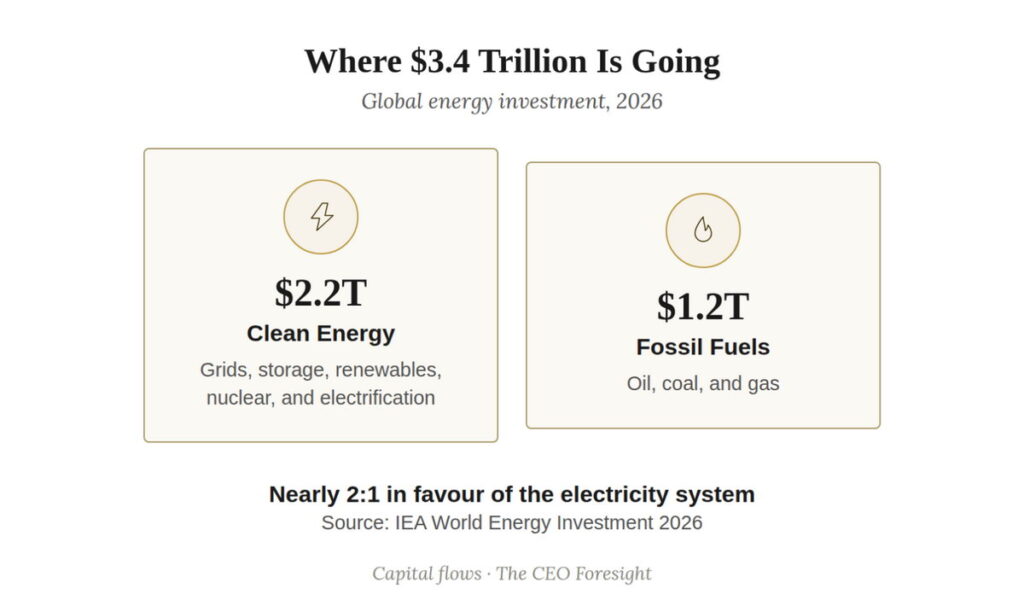
Global energy investment is on track to hit $3.4 trillion in 2026, and where it’s going tells you which system is winning: burning fuel, or running on electricity. Of that total, $2.2 trillion is going to grids, storage, renewables, nuclear, and electrification. Only $1.2 trillion is going to oil, coal, and gas. Electricity-related spending already makes up close to 60% of global energy investment, and once you include electrification on the demand side, that figure approaches $2 trillion. When most of a $3.4 trillion market moves in one direction, that’s not a policy signal. It’s a shift in market structure. Every company runs on power. That puts all of them inside an economy that’s rebuilding itself around electricity. That rebuild is still being shaped. The winners, the standards, and the rules of competition inside it are still being decided. Whoever helps set them now has a real advantage over whoever waits to follow them later.
Ambition is cheap. Timing isn’t
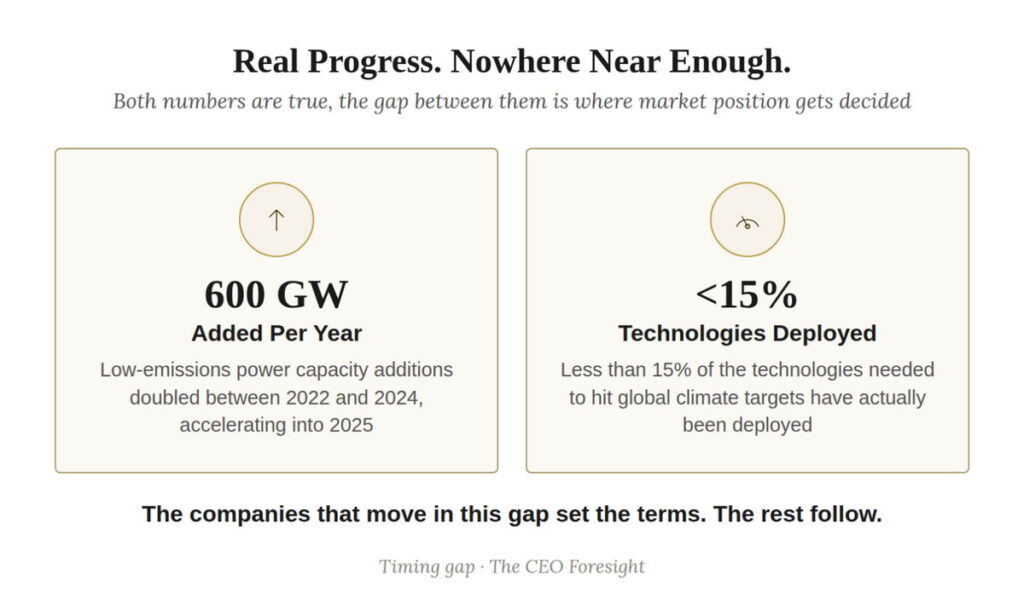
Nearly every large company now has a climate target. That alone stopped being the differentiator a while ago. What separates companies today is timing: knowing which constraint will bind next, and moving before it does. Business leaders who spot the next bottleneck and act early gain real advantage over those who wait. The numbers show why timing matters so much. Low-emissions power capacity additions doubled between 2022 and 2024, reaching around 600 gigawatts a year, and that pace picked up further into 2025. That sounds like fast progress. But less than 15% of the technologies needed to hit global climate targets have actually been deployed so far. Both numbers are true. Real progress, nowhere near enough.
hat gap between moving fast and not fast enough is where market position gets decided, and it plays out differently by region. US technology companies are signing their own power deals, including nuclear, to get ahead of data-center demand outpacing the grid. India’s solar and wind additions have outpaced expectations. Greek shipowners, who control one of the largest merchant fleets in the world, have committed more than $60 billion to green fleet renewal, and the share of Greek-owned vessels carrying at least one energy-saving technology has jumped from one in three in early 2024 to more than half today.
That lateness has a price. It shows up as financing offered on worse terms once a lender starts pricing in transition risk, as a supplier contract lost to a competitor who could document a credible plan, or as a permit application stuck behind one that came with a clearer energy strategy attached. It rarely shows up as a single dramatic loss. More often it’s a company that is quietly, consistently, a step behind on the decisions that compound. The advantage runs the other way too, and it looks different from simply avoiding the downside above. The best financing partners, the most reliable suppliers, and the clearest permitting paths tend to go to whoever moves first. The real advantage is choosing your terms instead of accepting whatever’s left.
Nobody owns the problem
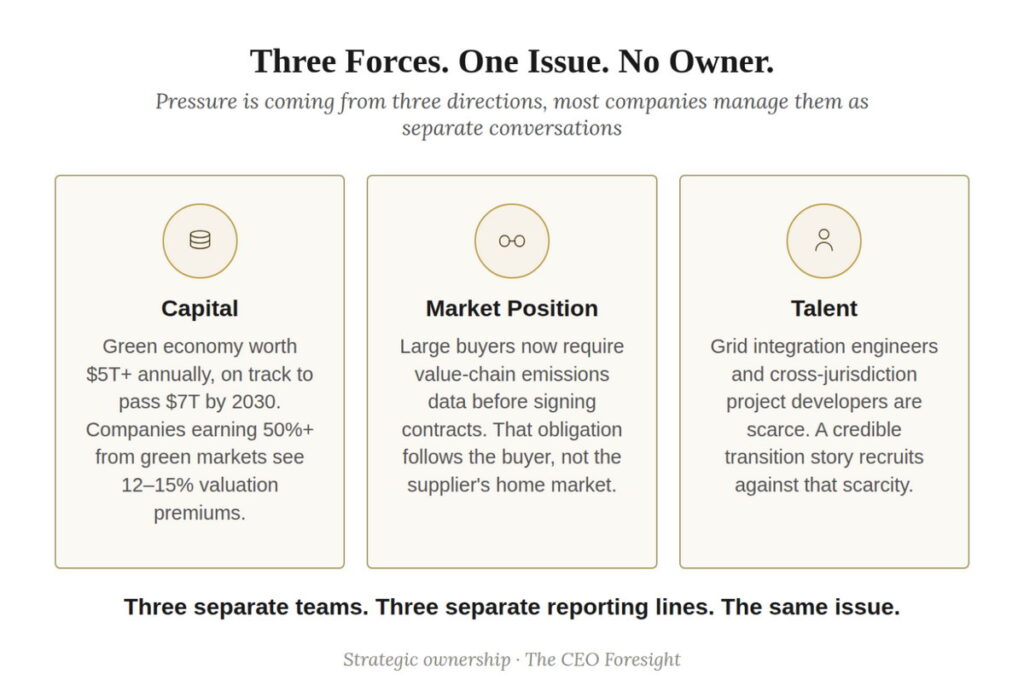
Acting on that timing sounds simple. In practice, it rarely happens, because the decision doesn’t sit with one person or one team. Pressure on this issue is coming from three directions at once, and most companies haven’t assigned it to one owner. On capital: the green economy is already worth more than $5 trillion a year and is on track to pass $7 trillion by 2030, growing roughly twice as fast as conventional revenue. Companies generating more than half their revenue from green markets are earning valuation premiums of 12 to 15%, and easier access to capital along with it. That’s a growth rate and a capital advantage that normally earns a dedicated strategy, not a footnote. On market position: large customers who must report their own value chain emissions, a rule most advanced in the EU but spreading elsewhere, are increasingly requiring the same data from their suppliers before signing a contract.
That obligation follows the buyer, not the supplier’s home market, so it can reach a company regardless of where it’s based. A company that can produce that data easily becomes a preferred partner in the supply chains that matter most. A company that can’t risks losing its place in one, long before it ever loses a sale on price or quality.
On talent: engineers who understand grid integration, and project developers who can handle permitting across jurisdictions, are hard to find. Companies with a credible transition story recruit against that scarcity more easily than companies without one. This directly affects which projects get staffed and which get delayed. Capital, market position, and talent are usually managed as three separate conversations, run by three separate teams, reporting up three separate lines. They’re the same issue.
The gap shows up at board level too. Risk committees track physical and regulatory exposure. Audit committees track the data quality that market position increasingly depends on. Strategy discussions track growth and capital allocation. Talent, more often than not, doesn’t get a line on that agenda at all. Each committee holds a piece of the file. Few boards have asked who holds all of it, or whether anyone should.

Where that leaves the CEO
This isn’t a case for moving fast everywhere. Some technologies are ready for scale, others aren’t, and capital that looks committed today can shift again, as recent energy security shocks have already shown. But the old framing, energy transition as a cost to manage down, doesn’t match where capital, growth and talent are actually heading. None of this requires a board with dedicated committees or a formal risk function. A company without any of that already raises capital, hires, and signs supplier and financing agreements on terms that are shifting either way. What it needs is one person asked to hold capital, market position, and talent together as one picture instead of three separate updates. The same shift that’s quietly costing the companies without such an owner is rewarding those that assign one.