


Elite sailing returns 10-13 June to the heart of Antiparos
Stratis Andreadis and Ilia Rigas reveal how the Cyclades Cup blends high-tech racing with authentic heritage, establishing Antiparos as a premier, owner-led destination on the global superyacht regatta circuit.
INTERVIEW Giorgos Katsimilis | PHOTOS GEORGE LOUVARIS
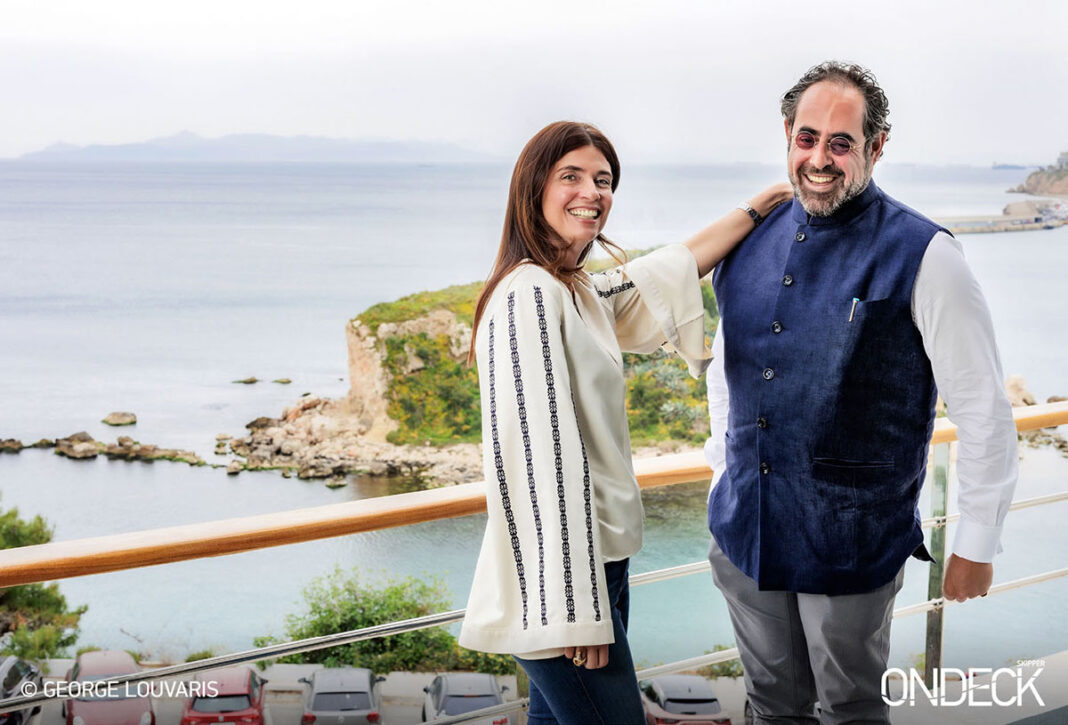
Stratis Andreadis and Ilia Rigas reveal to Skipper OnDeck their vision for the Cyclades Cup, the regatta that has redefined Greek yachting. By blending technical precision with the authentic Cycladic heritage, they have transformed Antiparos into a global superyacht hub, prioritizing the “Corinthian spirit” and a deep connection to the islands.
Stratis, as the Cyclades Cup enters its third edition this June, what are the key novelties or “surprises” we should expect this year?
The headlines for the third edition come down to four themes: new entries, old standbys, robotic marks, and TracTrac. On the water, we have a beautiful balance between fresh blood and family. There is a very strong cohort of new entries joining the Cup for the first time – owners and yachts that have decided this is the regatta they want on their summer calendar – racing alongside the old standbys, the boats and owners who have been with us since edition one and who carry the soul of the event. That mix of new energy and loyal continuity is exactly what we want a healthy regatta to look like. On the technical side, this is the year the Cup goes fully digital. We are deploying robotic marks that hold their station to the centimetre, regardless of current, leeway or wind shift, which allows us to set fairer, more precise courses for fifty-meter giants than any anchored buoy could ever deliver. And we are running live results and race tracking through TracTrac, so every move of every boat is followed second-by-second – by spectators ashore, by families back home, by the sailing press, and, frankly, by us in the race office. Between the new entries, the returning veterans, the robotic marks and TracTrac, this is the most ambitious edition we have ever put on the water.
Ιlia, you’ve stated that this event is “by owners, for owners.” What was that specific “void” you saw in the Mediterranean regatta circuit that inspired you to create the Cyclades Cup, and Stratis, how did you translate Ilia’s vision into a technical race reality?
ILIA: What I felt was missing was something more authentic. There are many beautiful events in the Mediterranean, but often they can feel overly polished, commercial, or disconnected from the true spirit of sailing. I wanted to create something that felt more personal, more genuine, and more rooted in place. The Cyclades Cup was born from the idea of bringing owners together in a regatta that is not just about performance, but about belonging, shared values, and the pleasure of sailing in one of the most naturally dramatic racecourses in the world. For me, the Cyclades are not just a backdrop; they are the essence of the event. This is a part of Greece where wind, light, history, and rhythm still shape life in a very real way. We wanted to offer something holistic: not simply a race, but an experience of the Cyclades in their deepest sense. That includes culture, history, hospitality, and a connection to the place itself. This year, for example, we are organising a guided visit to Despotiko with the archaeologist who discovered the ruins, because history and culture are deeply integrated into the identity of the Cyclades Cup. We want people to leave feeling that they have not only raced here, but truly experienced life here.
STRATIS: Somebody has to take a beautiful sentence – owners, an Aegean regatta with a soul, fifty- meter monsters racing across the bluest water on Earth – and turn it into the brutal arithmetic of a starting line. That is the part that lives on my desk: GPS-accurate marks dropped in deep, current- swept water; courses that respect the Meltemi instead of pretending to dictate terms to it; safety boats stationed where the geography actually wants them rather than where the map says they should be; and a rulebook tight enough for serious owners yet loose enough for the Corinthian spirit to breathe. Above all, it means race officers drawn from the very top tier of World Sailing. We have been extraordinarily lucky in that the same brain trust returns to run our racecourse year after year: Olympic gold medalist Shirley Robertson, the incomparable Alberto Pindozzi, Athanasios “Soulis” Papantoniou, Roula Flouri and Bill O’Hara. Between them they have probably forgotten more about world-class superyacht race management than most committees will ever know, and their continuity is the spine of everything we do – they are how we deliver, edition after edition, on what has always been the Cup’s foremost priority: the safety and wellbeing of every owner, crew member and competitor on the water. My half of the dream is the unglamorous half – the timing, the marks, the briefings, the safety plan, the contingencies for a Force 7 afternoon and for a flat-calm one, the radio plan, the rescue plan, the protocol for the moment a Greek god decides it is a perfectly fine day for a squall. Done well, this work makes the racing look effortless from the rail, and that is the standard our team works hard to uphold every edition.
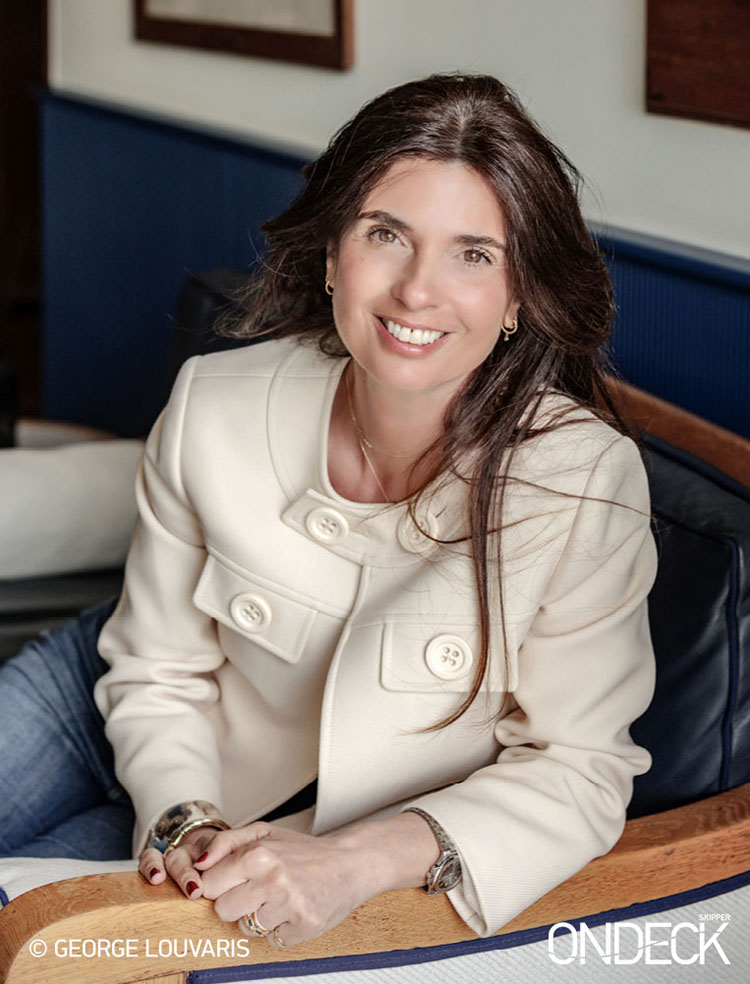
“Before the regatta starts, I am fully focused on the event as a whole: the owners, the experience, the logistics, the atmosphere, the details. But once I step onboard and we are racing, I have to let go and trust the team around me.”
Ιlia, you have two roles: Regatta Director and competing Owner of Almyra II. How do you manage the transition from making high-level organizational decisions to focusing on the tactical demands of the racecourse once you are behind the wheel?
It is definitely a dual role, and it requires discipline. Before the regatta starts, I am fully focused on the event as a whole: the owners, the experience, the logistics, the atmosphere, the details. But once I step onboard and we are racing, I have to let go and trust the team around me. By that point, the structure needs to be in place, and I need to switch mentally into being an owner and participant. In some ways, it actually helps me. Because I am also competing, I understand very directly what the owners feel, what matters to them, and what makes the experience memorable. It keeps me honest. I never want to create an event that looks good on paper but does not feel right from onboard. The fact that I experience both sides pushes me to make the Cyclades Cup more thoughtful, more personal, and more coherent.
Stratis, the Meltemi winds are legendary and often unpredictable. From a Race Chairman’s perspective, what are the technical complexities of organizing a safe yet exhilarating race for 50-meter giants in the heart of the Cyclades?
Thank you for the chance to dispel that silly old wife’s tale. As a matter of fact the Meltemi is almost as predictable as Immanuel Kant walking the streets of Königsberg. To wit: the Meltemi is one of the most highly predictable, stable seasonal wind systems on the planet, provided you understand the synoptic and local atmospheric engines driving it. If we look at the macro-scale predictability, the Meltemi isn’t some localized freak weather event; it is the direct result of a massive, stable planetary pressure gradient. During the summer, a strong high-pressure system establishes itself over the Balkans and Central Europe, often acting as an extension of the Azores High. At the exact same time, a deep, semi- permanent low-pressure trough forms over the Eastern Mediterranean and Anatolia. This trough is actually the far-western extension of the massive Asian Monsoon Low (often centered over Pakistan and northwestern India, which is why you might hear sailors loosely refer to distant Asian weather systems when discussing Aegean winds). Because these two massive pressure systems are relatively stationary throughout June, July and August, they create a highly predictable, persistent funnel that forces air southward over the Aegean Sea. As long as that macro-scale gradient exists, the Meltemi will blow. It is a matter of basic atmospheric mechanics. Where people confuse “unpredictability” with “variability” is in the Meltemi’s micro-scale daily behavior – specifically its diurnal and nocturnal oscillations. But even these oscillations are entirely systematic and predictable.
The daily cycle is driven by the physics of the planetary boundary layer and secondary thermal baroclinic circulation. Here is what happens:
- The Midday Peak: During the day, intense solar radiation heats the surrounding landmasses much faster than the sea. This creates localized sea breezes that align with and reinforce the overarching northerly gradient wind. Furthermore, this daytime heating creates thermal turbulence in the marine boundary layer, which physically pulls high-momentum air from the upper atmosphere down to the sea surface. This is why the Meltemi reliably peaks between noon and mid-afternoon.
- The Nocturnal Lull: At night, the mechanics reverse. The land cools rapidly, which stabilizes the boundary layer. This stabilization essentially “decouples” the surface winds from the stronger gradient winds aloft, cutting off that turbulent downward transfer of momentum. Additionally, the rapid cooling of the land can create localized land breezes that oppose the northerly flow, and recent atmospheric studies have shown that an inertial oscillation over the Aegean contributes to this nighttime dampening. This is why the wind reliably drops off, or completely dies, around midnight.
So, the Meltemi isn’t unpredictable at all. It operates on a very strict, scientifically measurable schedule. If a skipper gets caught off guard by it, it usually means they aren’t looking at the broader synoptic weather charts or anticipating the daily thermal cycles of the Aegean.
Perhaps your readers might benefit from a deeper dive into the Meltemi by reading:
Tropical and mid-latitude causal drivers of the eastern Mediterranean Etesians during boreal summer, and
The planetary boundary layer physical processes, the secondary thermal baroclinic circulation and inertial oscillation contribution to diurnal variation of the Etesian winds over the Aegean Sea | Atmósfera.
Antiparos is a gem of the Cyclades but not a traditional “superyacht hub” like Porto Cervo or St. Tropez. What makes this island the perfect spiritual home for the Cup, and how does its unique geography challenge the Race Committee’s planning?
ILIA: That is exactly why Antiparos is the right home. We were never trying to recreate Porto Cervo or St. Tropez. The idea was to build something that belongs here. Antiparos has a quiet elegance -it is refined, but still authentic. It hasn’t lost its sense of place. And around it, you have layers of history that go back thousands of years. That matters to us. We try to integrate that into the experience in a very natural way.
The guided visit to Despotiko is a good example -it allows our guests to understand where they are, not just pass through it. It creates a different connection to the place. So the regatta becomes more than sailing. It becomes a moment where sport, culture, and lifestyle come together. That is very much the feeling we want to create. The Cyclades Cup belongs here because the event reflects the same qualities. It is boutique by design. It is invitation-only, carefully curated, and built around relationships rather than scale. Antiparos allows us to offer something more meaningful than a glamorous stop on the calendar. It gives the event identity.
STRATIS: Antiparos sits in a different category from the great superyacht capitals – Porto Cervo, St. Tropez, Palma – places I deeply admire and, in the case of the Yacht Club Costa Smeralda, I am proud to call my own as a member. Those clubs and those harbours set the gold standard for our sport; they are world-class and the Cyclades Cup is built, in part, on the lessons they have taught all of us. What Antiparos offers is something complementary rather than competitive: an unspoiled Cycladic island that has held on to an almost private, intimate quality. You walk down the main drag at midnight and you can hear the cicadas arguing with the sea, you can smell the wild thyme and somebody’s grandmother frying something in olive oil, and the village is small enough that everyone knows each other by Wednesday. That is the spiritual home of an owners’ regatta: a place where the island remains larger than the brand.
The Race Committee’s headache, of course, is that the same gorgeous, unspoiled coastline is also one of the most logistically demanding stretches of water in the Aegean. You have Antiparos itself, Despotiko to the southwest, the Small Cyclades chain stretching east into the deep blue like a string of dropped pearls, narrow channels, sudden depth changes, currents that read the Meltemi like Braille, and local fishing communities whose families have been working those waters since Homer was a stringer. Setting a course for fifty-meter superyachts through that maze is not race management; it is three-dimensional chess against the wind, the geology, and a few thousand years of local tradition. Which is precisely the point. If it were easy, somebody else would have done it already.
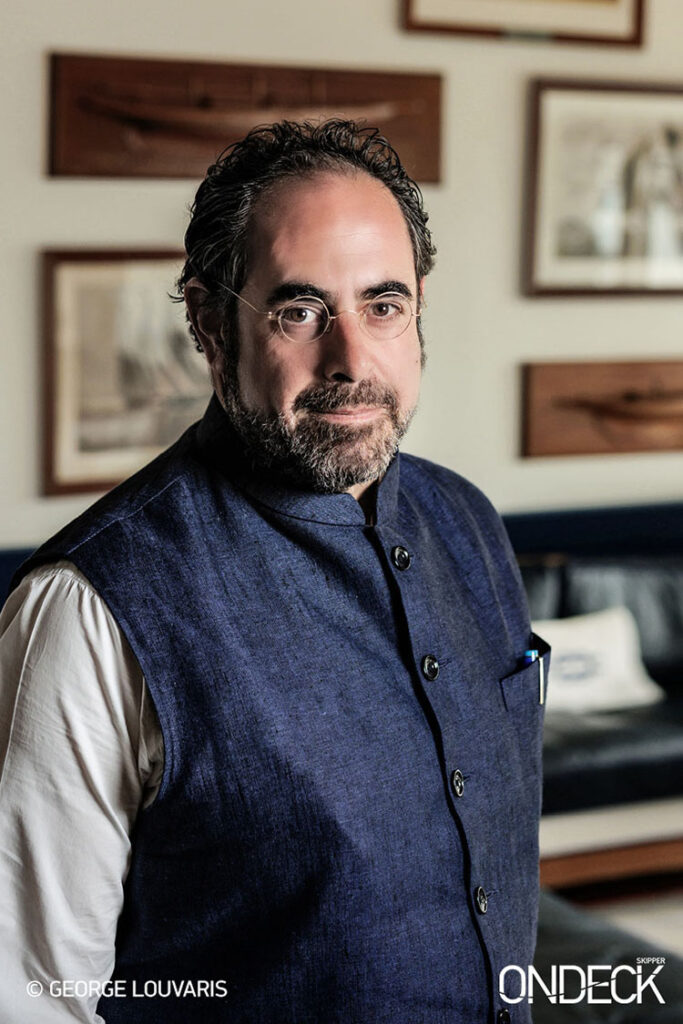
“Somebody has to take a beautiful sentence -owners, an Aegean regatta with a soul, fifty-meter monsters racing across the bluest water on Earth- and turn it into the brutal arithmetic of a starting line. That is the part that lives on my desk.”
Both of you have extensive experience in international yachting. How does the Cyclades Cup serve as a platform to redefine Greece’s position in the global superyacht regatta calendar, moving beyond just a cruising destination?
ILIA: Greece has always been one of the most extraordinary cruising destinations in the world, but I believe it deserves a more permanent place on the superyacht regatta calendar as well. The Cyclades Cup is part of that evolution. We want to show that Greece can offer not only beauty, but also sporting credibility, originality, and a world-class owner experience. What makes Greece unique is that the sailing is real. The landscapes are powerful, the conditions are technical, and the cultural depth is unlike anywhere else. When you combine that with proper organisation and the right community, you have all the elements for a truly important international regatta. We are not trying to imitate anyone else. We are trying to reveal Greece in a new way, on its own terms.
STRATIS: For decades, the international superyacht set has treated Greece like a particularly photogenic gas station – fill up in Athens, swing past Mykonos for the photographs, pour the captain a drink, and run back to the western Med. That is an offensive piece of cartography and it is flat-out wrong. The Aegean is the original. Every other yachting cruising ground in the Mediterranean is, in a sense, a tribute act. The Cyclades Cup is the regatta we built to put Greece back at the head of the calendar where she belongs – not as a destination, but as a fixture. We want owners to plan their season around June in Antiparos the way they plan around September in Porto Cervo, and that requires hard, technical regatta work behind the romance: world-class race management, courses that genuinely respect fifty-meter giants, accommodations and shoreside that match the boats, and a culture that treats owners like adults rather than marketing assets. The cruising-only chapter of the Greek yachting story is over. The regatta chapter is just getting underway, and the Cyclades Cup intends to be the cornerstone of it.
Τhe Cyclades Cup emphasizes the “Corinthian spirit” of fair play and camaraderie. In an industry often driven by intense competition, how do you ensure that the event maintains its soul as a community gathering rather than just another commercial trophy chase?
ILIA: It starts with intention. From the beginning, we were very clear that the Cyclades Cup should feel personal, respectful, and owner-led. We are not trying to become the biggest event. We are trying to create the right event. That means being selective, protecting the atmosphere, and making sure the people who come understand what this regatta stands for. The Corinthian spirit is not just a phrase for us. It is in the way we invite, the way we host, and the way we bring people together. The social side matters enormously, because it creates the human connections behind the competition. We want owners, guests, and crews to feel they are part of something with warmth and character. The racing is serious, but the spirit around it must remain generous, elegant, and joyful.
STRATIS: The “Corinthian spirit” is one of those phrases that gets tossed around the yacht-racing world until it means absolutely nothing – a kind of wallpaper phrase, sounds elegant, costs nothing, commits you to less than a stock photograph. We mean it. The minute a regatta becomes a trophy chase, the minute the owners stop talking to one another at the bar and start glaring across the protest room, you have lost it; the boat dies long before the prize-giving. So we built the Cup around the people, not the silverware. We keep the fleet small enough that everybody knows everybody by Wednesday. We put owners and crews and families and locals in the same rooms eating the same lamb at the same long tables. We run a clean, fair, technically rigorous race with serious rules and zero theatrics. And we have made it culturally clear from day one that anyone who turns up looking to commercialise the soul of the event will find themselves politely uninvited. It is not just another trophy chase. It is, if we have done our jobs properly, the regatta you call your friends about on the flight home.
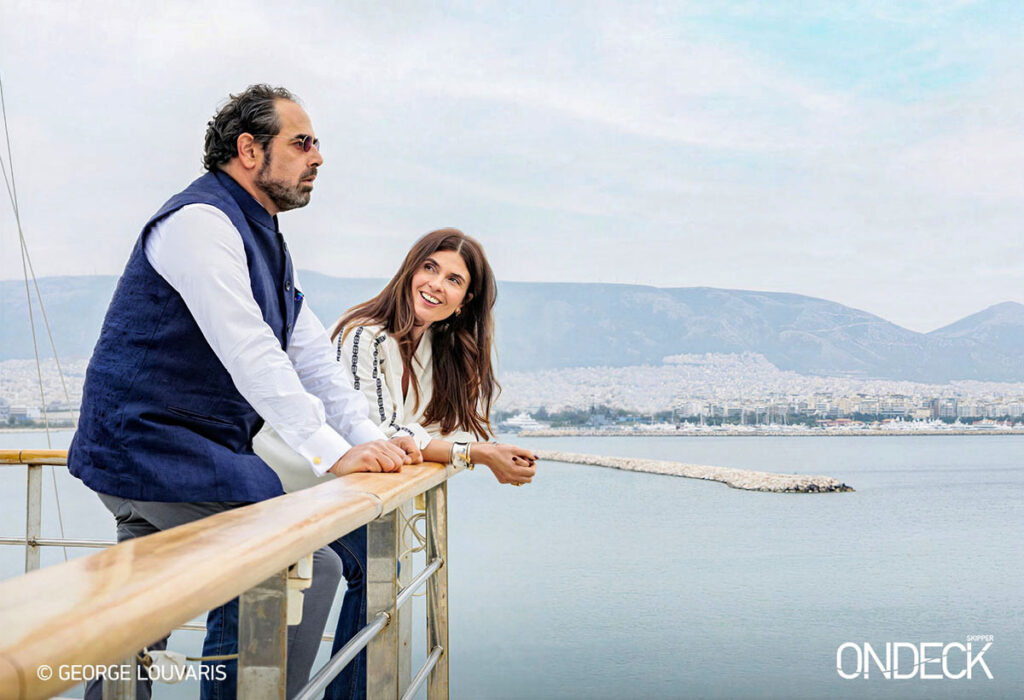
Τhe Cyclades are a delicate ecosystem. As leaders of this event, what concrete steps are being taken to ensure the Cup leaves a positive footprint on the local community and the marine environment of the Small Cyclades?
ILIA: This is very important to us, because the whole philosophy of the Cyclades Cup is rooted in respect for place. We are guests in an extraordinary environment and in a living community, and that comes with responsibility. For us, positive impact is not a side note. It is part of the identity of the event. One important aspect is cultural connection. We want participants to engage with the heritage of the islands, not just pass through them. That is why experiences such as the guided visit to Despotiko matter so much. They remind people that this landscape carries thousands of years of history and meaning. We want the Cyclades Cup to celebrate not only sailing excellence, but also the cultural richness of this part of Greece. At the same time, we work to ensure the event supports the local economy in a respectful and meaningful way, through local partnerships, local suppliers, and a thoughtful scale. We are intentionally not a mass event. We believe a more curated model is also a more responsible one. The Cyclades Cup is not just a regatta -it is a way of experiencing the Cyclades, where sailing, culture, history and human connection come together.
STRATIS: Anybody who has spent ten minutes in the Cyclades knows it is a fragile place wearing the disguise of a tough one – the rocks fool you, the sun fools you, but the Posidonia meadows and the fish stocks and the fresh-water table and the small island communities are all balanced on a knife edge, and one careless season of fifty-meter yachts could undo something it took ten thousand years to build. We are not going to be the people who undo it. . The Cup operates a hard, written environmental protocol – including a strict no-anchoring rule on Posidonia meadows – alongside a community-spend program that puts the regatta’s money back into the islands hosting us: local crews, local kitchens, local boatyards, local artists, instead of importing a pop-up village from somewhere else and helicoptering it back out at the end of the week. The footprint we want to leave on the Small Cyclades is the same one we want to leave on the racecourse: clean, considered, and worth coming back to next year.