


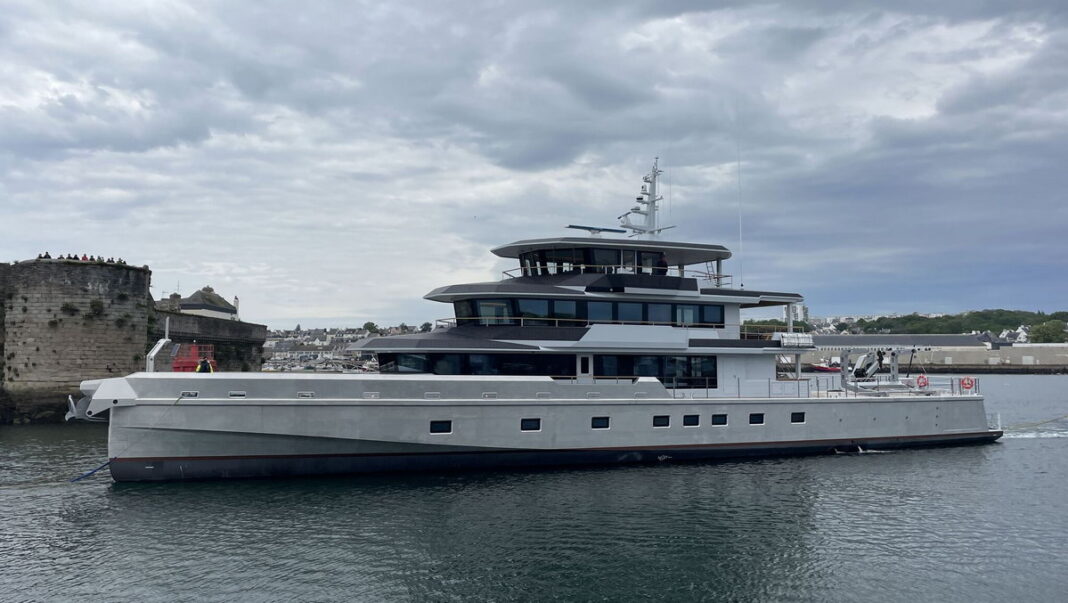
Sea trials have begun for the custom 50m Humphreys Explorer, a hybrid-powered vessel combining long-range efficiency with sustainable, silent cruising.
Sea trials commenced last week for the new 50-metre Explorer Yacht, a fully custom aluminium construction designed by Humphreys Yacht Design (HYD). Built by the French shipyard JFA Yachts, the vessel is the result of close collaboration between the design office and the client, aiming to create a high-endurance craft for global cruising with an emphasis on efficiency and family use. This superyacht represents the pinnacle of high-performance exploration, tailored to meet the rigorous demands of sustained self-sufficiency in the world’s most remote maritime regions.
Naval architecture focused on material innovation
HYD undertook the entirety of the naval architecture and exterior styling, while the interior was designed by m2atelier. A combination of materials was selected for the construction: the hull and lower superstructure are made of aluminium, while the upper tiers are built from composite materials. This choice aims to minimize weight and achieve a lower centre of gravity, thereby improving the vessel’s stability and ensuring optimal performance even in heavy seas. A key feature of the design was the owner’s requirement for unobstructed 360-degree visibility from nearly every vantage point on board. This led to a structure with single-level decks, relatively low freeboard in the forward section, and extensive glazing throughout the superstructure. The main deck serves as the social hub, featuring a spacious galley with adjacent cold and dry storage, alongside a sophisticated main saloon and dining area. Externally, the main deck is equipped with a bar, integrated BBQ, and versatile sunbed areas for relaxation.
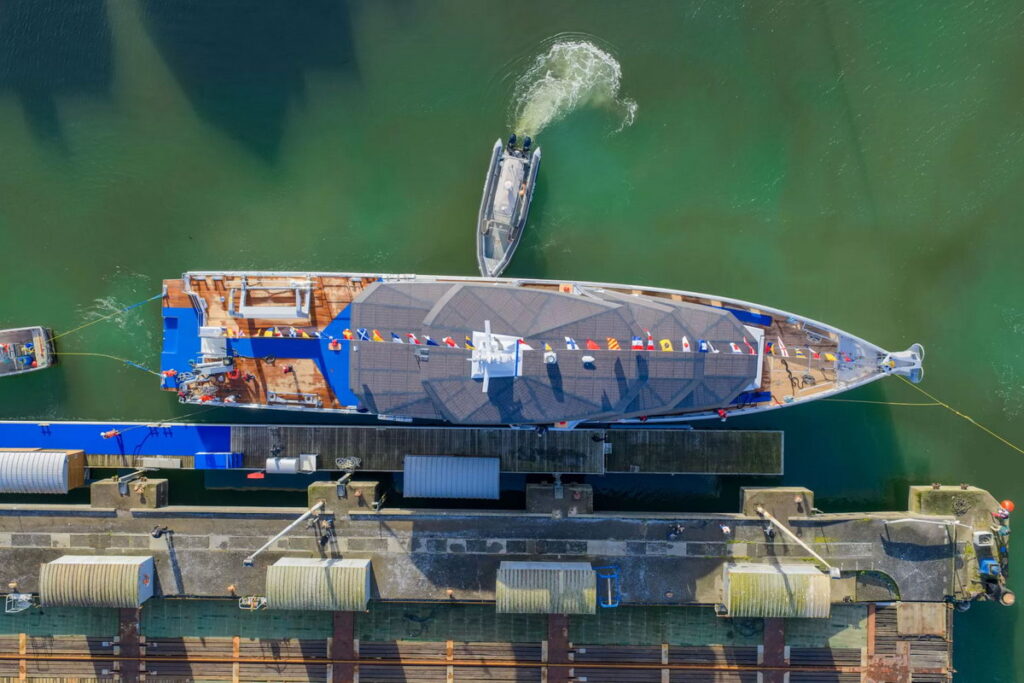
Inside, the owner’s suite is located on the upper deck and includes a private lounge, office, and an exterior area with a Jacuzzi, providing a secluded sanctuary with a full exterior walkway. In total, the yacht accommodates 10 guests in four cabins on the lower deck, with quarters provided for a crew of 10. A particular technical challenge was the integration of a centerline walkway on the tank deck, allowing the crew direct access to the engine room from the forward crew area without interfering with guest spaces—a rare and complex engineering feat for a light-displacement vessel of this size.
Hybrid Propulsion and Sustainability
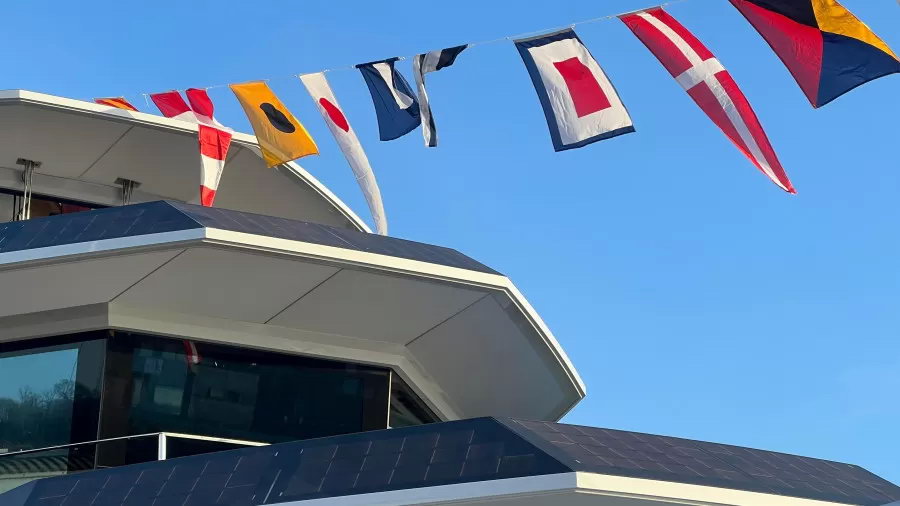
In terms of propulsion, the vessel utilizes a parallel hybrid system with twin shafts, powered by MTU 12V 2000 M72 diesel engines coupled with ZF 3351 PTI/PTO gearboxes and 290kW Danfoss electric motors. The maximum speed reaches 20 knots in hybrid boost mode, while its range exceeds 5,000 nautical miles at a speed of 12 knots. This efficiency makes it an ideal platform for long-range transoceanic passages. The Explorer is also equipped with an extensive array of solar panels and a high-capacity battery system, enabling silent, emission-free operation during time at anchor or when cruising at low speeds. This focus on eco-friendly technology ensures that the yacht can operate in sensitive environments with minimal impact.
Particular emphasis was placed on reducing vibration and noise through specialized soft mountings, ensuring a peaceful environment for all on board. The hull form was perfected through extensive RansCFD studies conducted with Cape-Horn Engineering, and scale model tank testing. Engineers paid specific attention to pitch damping and vessel motions to exceed comfort criteria. For passenger safety and comfort, the yacht features a Veem VG140SD gyroscopic stabilizer and a pair of CMC LR170 zero-speed fins, ensuring stability even in challenging weather conditions. Additionally, transom-mounted CMC intruders allow for enhanced running trim control. For exploration, the aft deck features a dedicated 9.25m tender launched via a C-davit, while a Palfinger deck crane and a concealed foredeck crane handle the rescue boat and jet skis with ease.