


Fountaine Pajot turns fifty in 2026, celebrating five decades of catamaran innovation with a fully renewed range and a 2050 carbon-neutral goal.
In 2026, Fountaine Pajot turns fifty, and its journey reads like a story that began with a bold dream. The shipyard was founded in 1976 by four racing enthusiasts trained as naval engineers: Jean-François Fountaine, Yves Pajot, Daniel Givon and Rémi Tristan. Pierre Fountaine soon joined them. Their goal was to combine technical excellence, innovation and a deep understanding of users, first in racing boats and then in catamarans.
From Racing to the Cruising Catamaran
The shipyard started out with racing boats. In the early 1980s it built the Royale trimaran and the Charente Maritime catamaran for offshore racing, and in 1983 it launched the Louisiane 37, introducing the concept of the series-produced cruising catamaran. At that time the segment did not exist. This choice helped structure the global cruising multihull market. With a consistent product range, investment in its industrial infrastructure and an early international presence, particularly in North America and Australia, Fountaine Pajot established itself as a benchmark. Over fifty years, the shipyard has designed more than 60 models. Iconic examples include the Athéna 38, Belize 43, Mahé 36, Lipari 41, Saba 50, Lucia 40 and Isla 40, along with the more recent FP44 and FP51. The company has also helped raise industry standards. It was a pioneer of infusion moulding, and the Mahé 36 was the first boat moulded entirely under vacuum. It has optimized interior volumes and onboard circulation, maintained a balance between comfort and sailing performance, and progressively integrated renewable energy solutions.
2026: A Year of Complete Renewal
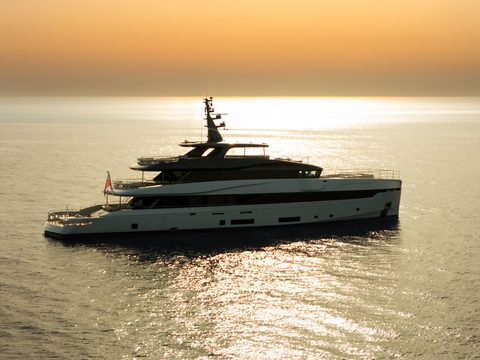
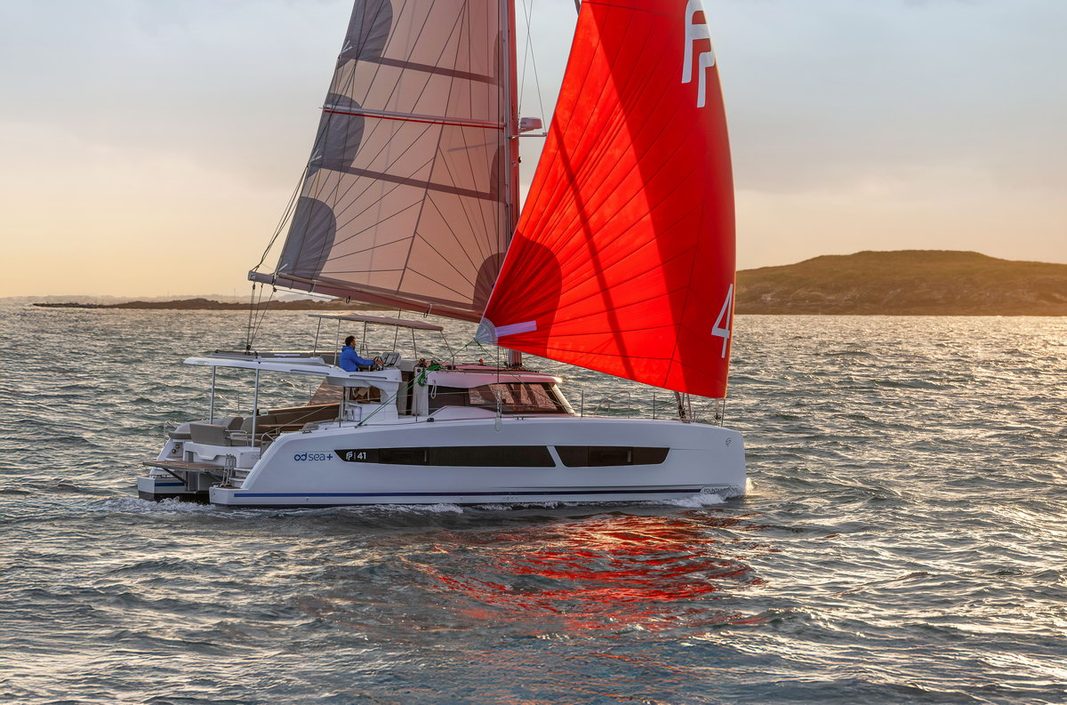
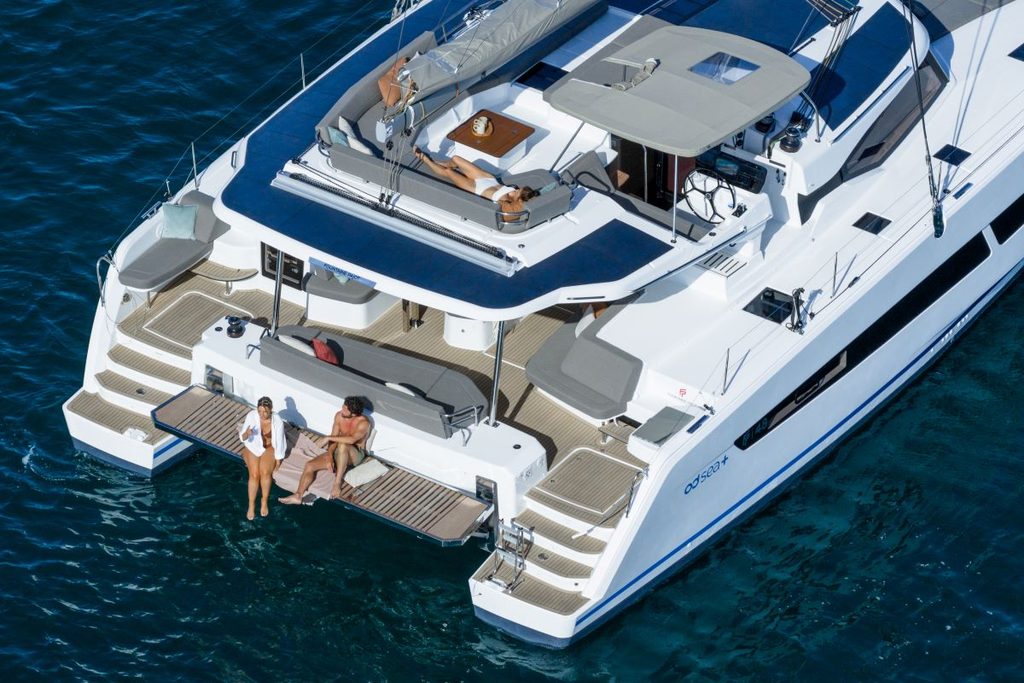
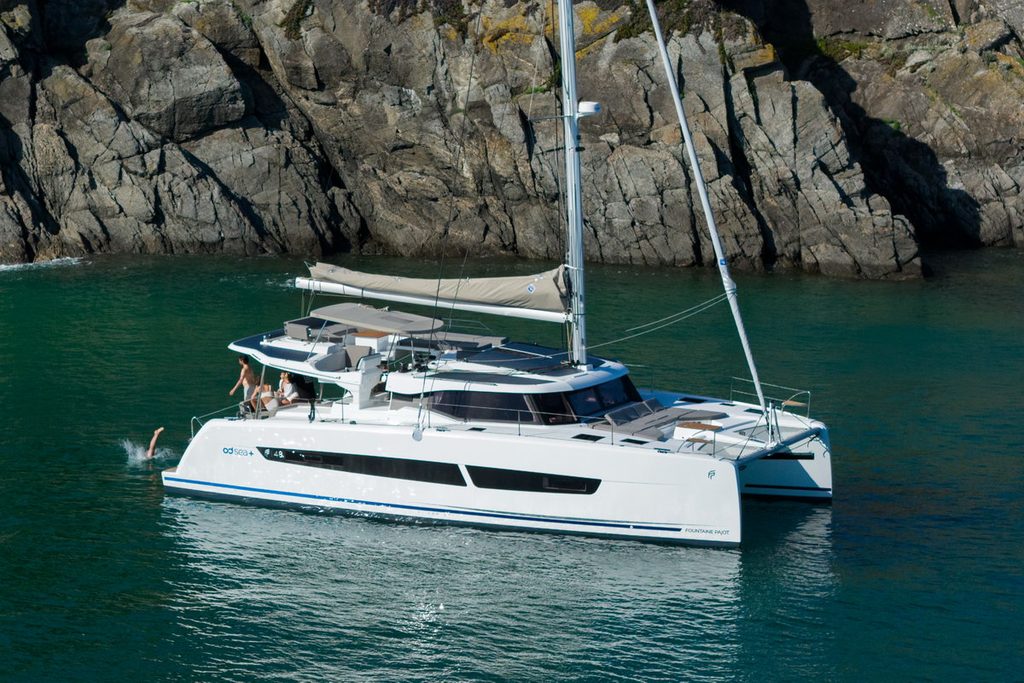
The 50th anniversary opens a new phase. The range is being fully renewed, with a focus on living spaces, perceived quality and the native integration of electric and hybrid solutions. The FP41 and FP44 take over from the Isla 40 and Astréa 42, while the FP48 and FP55 were unveiled in Cannes in 2026. Photovoltaic panels can generate up to 2,000 watts and lithium batteries meet new standards, making sailing more eco-responsible. At the same time, the shipyard created Fountaine Pajot Yachts, a new brand dedicated to large vessels, with models such as the FPY70S and FPY80, and a 120-foot yacht coming soon. The Group can now address every segment of the cruising catamaran market, from the core range to the ultra-premium.
An International Group with Family Governance
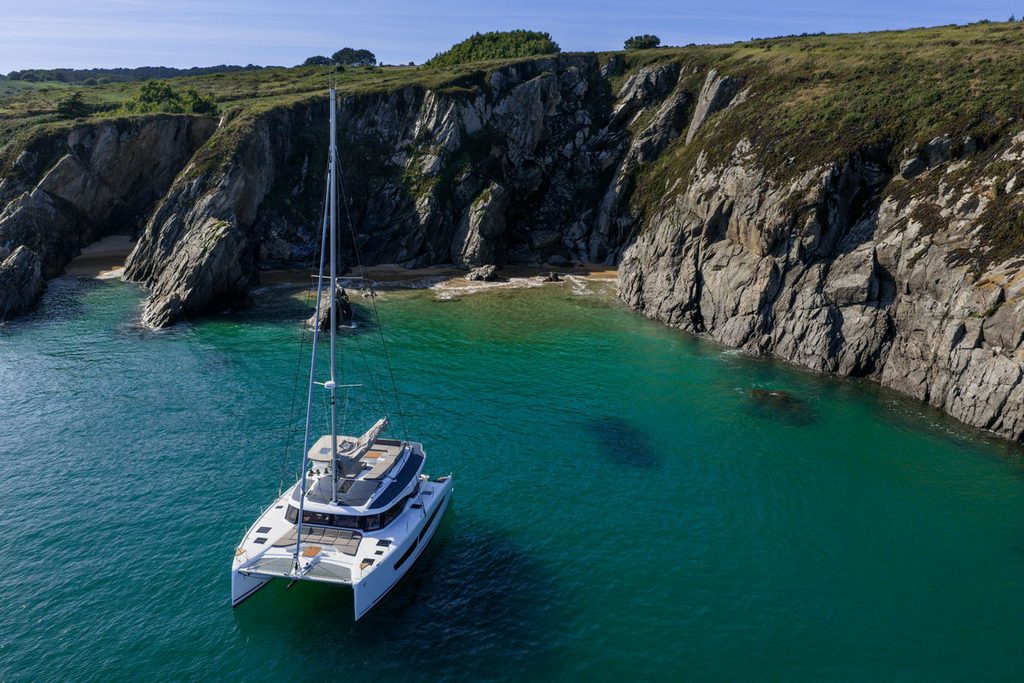
Today, nearly 5,000 Fountaine Pajot catamarans sail the world over. The Group employs 1,600 people and operates three main production sites: the historic Aigrefeuille-d’Aunis site (22,744 m²), the La SCAN site in La Rochelle for large vessels (15,180 m²), and the Le Thou site (6,160 m²) for cabinetry and fabric and foam cutting. In fifteen years, production has multiplied by four while quality standards have improved. Governance remains stable and family-led. Claire Fountaine is Chair of the Board of Directors. Nicolas Gardies, Chief Executive Officer, is supported by Mathieu Fountaine and Stéven Guedeu as Deputy Chief Executive Officers. As Gardies puts it, leadership does not rest solely on volumes, but on the ability to sustainably structure a market.
Heading Toward a Carbon-Free Cruise
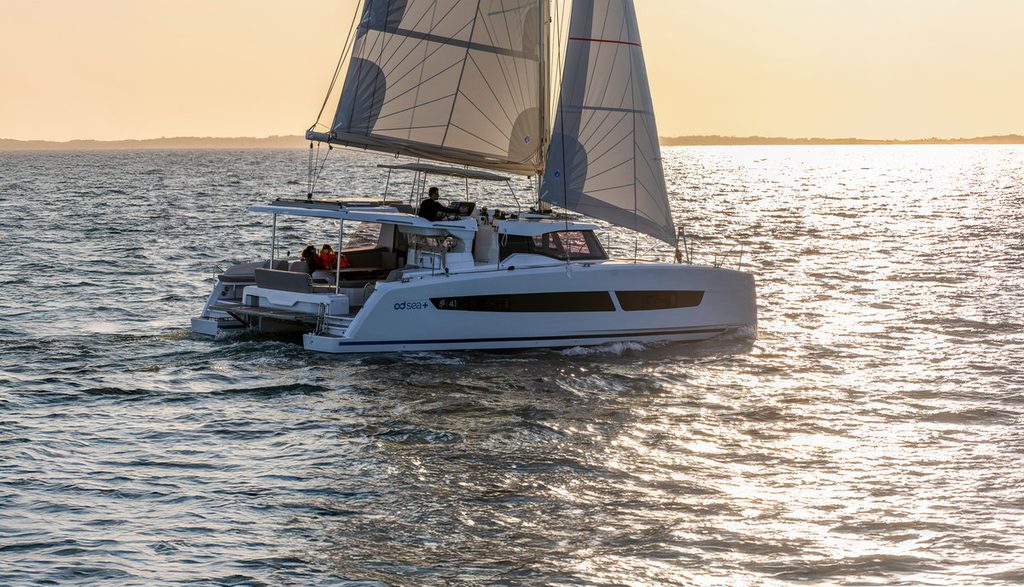
A pioneer of eco-cruising since 2011, Fountaine Pajot follows a structured climate strategy based on a complete assessment of its greenhouse gas emissions, in line with the GHG Protocol. Its central tool is ODSea+, the integrated hybrid electric solution combining photovoltaic panels, high-capacity lithium storage, intelligent energy management, hydro-generation under sail, and hybrid and electric propulsion. The Group aims to cut its emissions by 50% to 60% by 2030 and to reach carbon neutrality by 2050.
A Commitment to Oceans and Forests
Since 2023, the company has partnered with WWF France to protect Posidonia seagrass meadows in the Mediterranean. It has more recently joined a coalition of companies supporting WWF in preserving the primary forest of the Congo Basin. To mark its 50th anniversary, it also created the Fountaine Pajot Foundation, hosted by the Fondation de France and led by Morgane Motteau. It rests on three pillars: facilitating access to the sea, particularly for young people far from this world; raising awareness of oceanic and climate issues; and supporting concrete initiatives in favor of marine biodiversity. Fifty years on, Fountaine Pajot continues with the same ambition: to sustainably structure its market, strengthen its international leadership and accompany the evolving expectations of owners.