


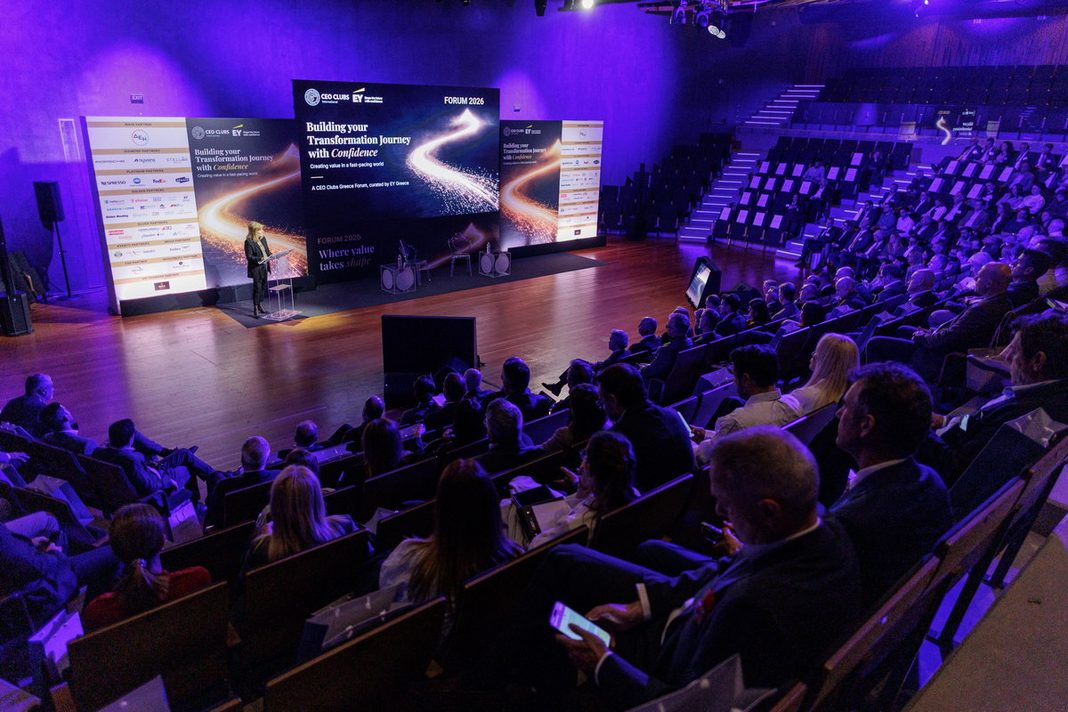
Leaders explored continuous transformation, AI adoption, customer shifts, and growth financing at the CEO Clubs Greece November 2026 Forum.
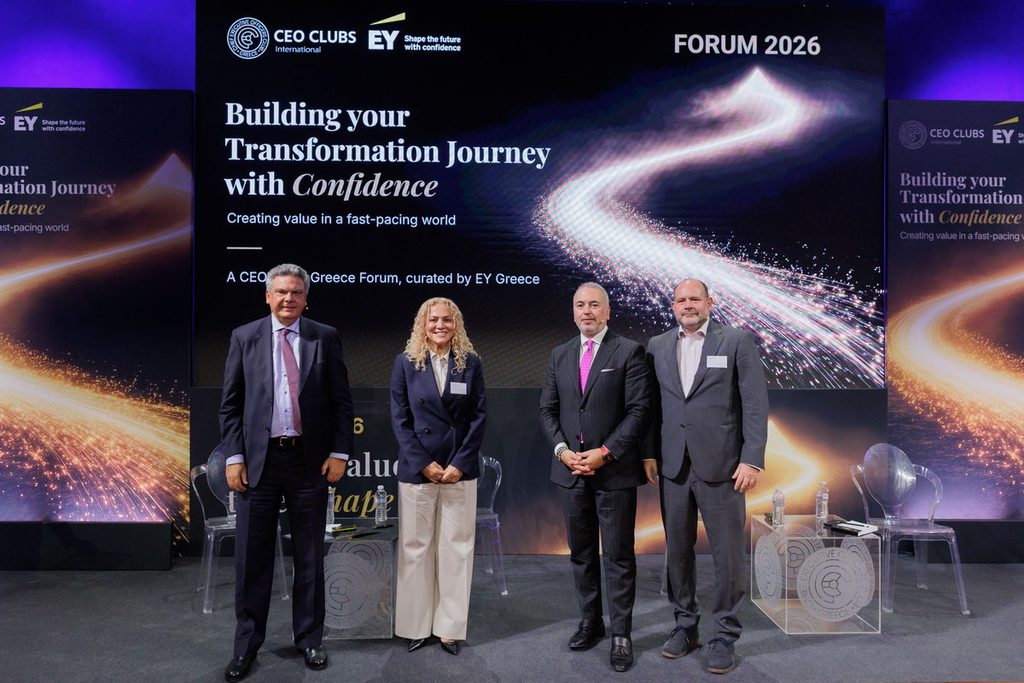
Business leaders today face overlapping pressures: geopolitical tension, rising energy and input costs, rapid AI adoption, shifting customer behavior, and skills shortages. Because assumptions can shift within a single budget year, transformation is no longer a finite project but a continuous operational discipline. This was the focus of the CEO Clubs Greece November 2026 Forum, “Building Your Transformation Journey with Confidence”, held on 12 November 2026 at the Athens Conservatoire and curated by EY Greece.
Decision-making without certainty and margin pressure
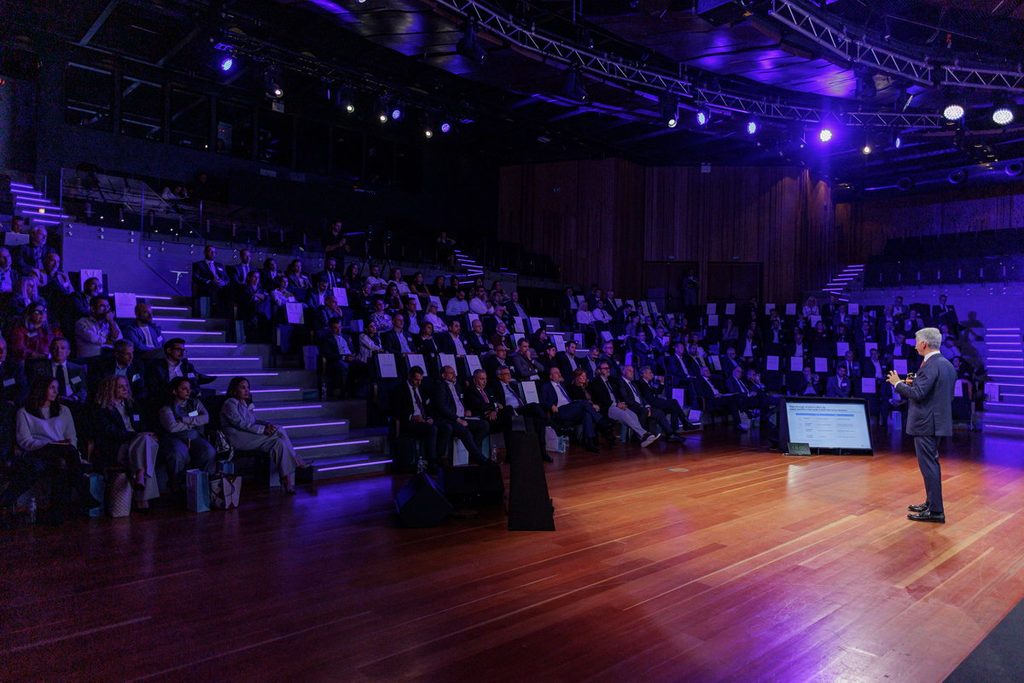
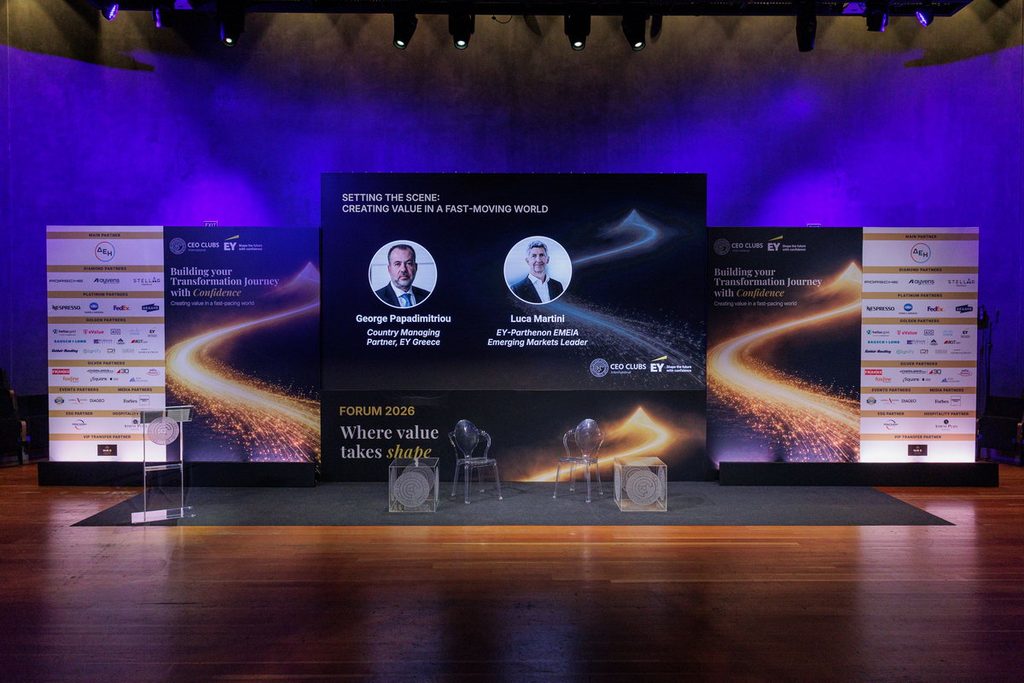
In the opening session, George Papadimitriou noted that in an unstable environment, leaders can no longer offer certainty about plans or outlook, but rather clarity on what is known, what actions follow, and what is mere noise. With three- to five-year forecasts no longer providing a reliable advantage, competitiveness must come from customer relationships, people, and access to capital—requiring leaders to run today’s and tomorrow’s companies simultaneously. Luca Martini examined the impact on Greek businesses. Energy-driven inflation raises input costs, yet eroded household purchasing power and weak consumer confidence make passing costs onto prices difficult. Furthermore, electricity costs in Athens rose around 33% this year, compared to an average of roughly 4% across EU capitals. To protect margins, he outlined three courses of action:
- Innovation: Greek firms invest roughly half as much as their European peers. Setting up a small corporate venture arm to invest modestly in start-ups close to the core business helps bring innovation back in-house.
- Cost reduction: Fewer than one in ten Greek companies use AI, largely due to reluctance to start, despite its potential to handle routine customer contacts. Against Chinese competitors, who hold a 20–30% cost advantage and rapid product cycles, Greek firms hold ground where quality and origin matter.
- Scale: Achieving scale requires acquisitions, shared platforms, or outside capital, which depends on sound governance and a structured board rather than a one-person model.
Panel 1: The customer in an AI world
Achilleas Arvanitis and Vicky Koura (EY Greece) explored how AI reshapes customer discovery and loyalty. Over eight in ten consumers trust AI-generated recommendations (EY Future Consumer Index, 2025), meaning companies omitted from an AI shortlist lose all visibility. Businesses must track AI recommendations, provide complete machine-readable data, and manage online reputation across review and comparison sources. While 60% of consumers are open to conversational AI (EY Studio+, 2026), human interaction remains essential during sensitive moments like fraud or complaints. As customers begin deploying their own AI agents, sustainable differentiation shifts toward originality, emotion, and customer experience.

Panel 2: The human side of AI
Eftichia Kasselaki and Samantha Matsa (EY Greece) addressed why companies with the same technology achieve vastly different outcomes. According to EY’s Work Reimagined Survey (2025), 88% of employees use AI, yet only 5% use it to transform how they work and just 12% receive sufficient training, while 44% of CEOs struggle to show financial returns (Gartner, 2026). Initiatives often stall at the pilot stage due to limited training, job insecurity, weak governance, and lack of external collaboration. With 39% of core worker skills expected to change by 2030 (World Economic Forum, 2025), Greece holds a distinct advantage: the highest rate of generative AI use among 16- to 24-year-olds in the EU. Ultimately, what remains uniquely human is intent—framing the right problem to solve.

Panel 3: Financing growth and value creation
Moderated by Tassos Iossiphides with Nikos Mantzoufas, Nikos Bris, and Sofia Kalomenides (EY Greece / EY-Parthenon), the final panel stressed that capital is available, provided companies are well-organized and combine funding sources. Direct EU programs like the €40 billion Innovation Fund, which has already approved six Greek projects, remain underused. Nationally, as the Recovery Fund concludes, the Hellenic Development Bank will lead SME financing, including a roughly €1.1 billion fund expected in early 2027. Meanwhile, private equity funds (managing around €3.3 billion backed by the Development Bank, roughly half uninvested) bring governance, talent, and international reach, often serving as a stepping stone to an IPO, where management trust and the Athens Exchange’s integration into Euronext create new opportunities.
In closing, speakers emphasized that true transformation creates value only when strategy, customers, people, and capital are deliberately aligned.