


Sailing boat premieres at boot Düsseldorf.
05.12.2025
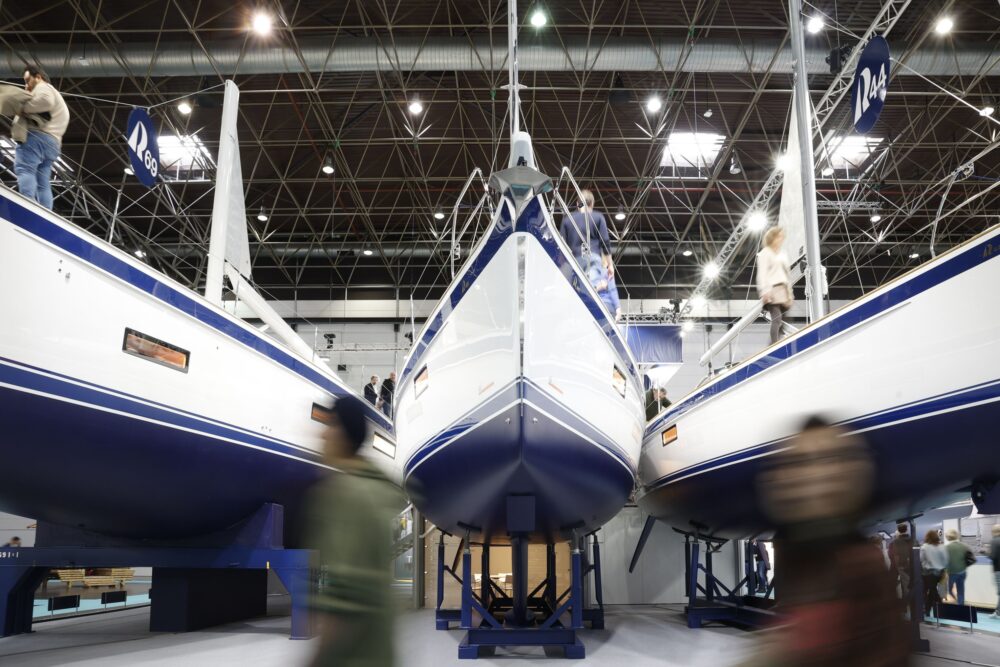
As the world’s largest water sports trade fair, boot Düsseldorf will once again be an attractive destination in 2026 for anyone interested in nautical topics. Visitors with an affinity for sailing can look forward to numerous interesting models and new releases that will be on public display for the first time
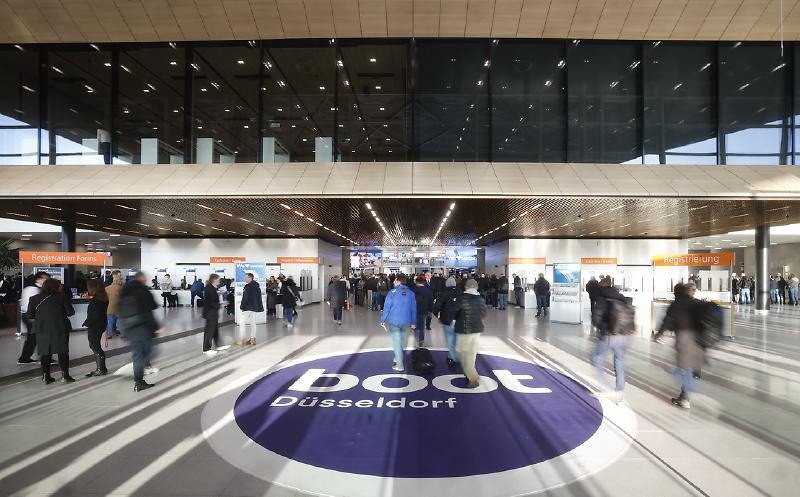
For nine days, from 17 to 25 January 2026, Düsseldorf will be transformed into a mecca for water sports. Around 1,500 exhibitors will present their offerings and products in 16 halls – nowhere else in the world can you get a better overview of the entire nautical scene. Sailing has always been a central aspect of the trade fair and is represented accordingly.
In the seaworthy yacht segment, there are several world and German premieres to be seen this year. Also of great interest are the models that have made it to the final of the European Yacht of the Year (= EYOTY) award and thus have a chance of winning the most important continental award in the industry. Below you will find the corresponding yacht profiles, data and prices.
World premiere Hallberg-Rassy 370
The renowned Swedish shipyard is presenting a new model with an aft cockpit, the Hallberg-Rassy 370. As usual, it was designed by Frers Yacht Design, resulting in a yacht with a wide stern, double rudder system, lead keel and bowsprit.
The voluminous fore ship ensures balanced sailing performance, while the genoa, which is sheeted far inside the cabin roof, provides good height when tacking. A self-tacking jib is available as an option. With its fixed windscreen, blue stripes on the hull and superstructure, and high side coamings in the cockpit that guarantee safety even in inclement conditions, the yacht is instantly recognizable as a Hallberg-Rassy – brand management as it should be.
The mainsail is sheeted via the traveler mounted in front of the windscreen on the cabin roof, which increases comfort for crew members and creates the perfect conditions for a bimini. New in this league is the optional bow or stern thruster.
Finally, look below deck: numerous hull and deck hatches create a bright, friendly atmosphere and allow for good ventilation.
The feeling of space is remarkably generous due to the width of 3.75 m, and the interior is available in either a traditional (khaya mahogany) or modern (light oak) finish. The layout provides for two cabins, with the bow cabin being equipped with either an island bed or a conventional triangular berth, each including seating. On the starboard side, immediately next to the companionway, there is a wet room with a oilskin locker and separate shower, and on the port side there is an L-shaped galley.
In addition to the standard refrigerator, a front-loading refrigerator can also be ordered, and an extra freezer box can be stored in the stool in front of the navigation station. The saloon with L-shaped bench, folding table and bench opposite is conventionally equipped, but Hallberg-Rassy is offering two sofas with a bar and bottle compartment as an alternative for the first time.
Hallberg-Rassy 370, Hall 16/A58
Hull length: 11.32 m, width: 3.75 m, draught: 2.0 m, weight: 8 t, sail area: 79.6 m2, price (excl. VAT): SEK (Swedish kronor) 4,620,600 (approx. €421,000)
World premiere Saffier SE 28 Leopard
The new model from Saffier combines the best of its sisters – the compact size of the Saffier SE 27 Leisure, the generous space of the Saffier SE 33 Life and the modern design of the Saffier SE 24 Lite. The hull has been completely redesigned: a negative stem, wide, flat stern and modern, effective appendages (keel & rudder) are prerequisites for excellent sailing performance and enjoyment.
The sophisticated ergonomics of the cockpit layout and the suitability for solo sailing have been retained. All halyards, stretchers and sheets can be operated from the helm, the high coaming allows comfortable seating, and the flat windscreen provides protection without disturbing the sporty lines of the flat superstructure.
Below deck, the Saffier SE 28 Leopard offers an astonishing amount of space and comfort for a model of this type, with a double berth in the fore cabin, two berths amidships and a two-part galley block. There is even room for an (optional) wet room, which allows the daysailer to be converted into a weekender for up to four people.
A wide range of versions, options and equipment packages allows customization to suit individual needs. For example, instead of the classic Yanmar built-in diesel engine (15 hp), you can order an electric pod drive (7.5 kW), replace the standard tiller steering with two steering wheels – on a 28-foot boat, mind you! – and choose between three keel variants (length: 1.15 – 1.75 m).
Last but not least, there are also two equipment packages available: ‘Comfort’ includes all the accessories you need for relaxing hours on the water, while ‘Racing’ is aimed at performance-oriented use and includes a carbon mast and an exclusive 3Di sail wardrobe from North Sails. Of course, all extras can also be put together à la carte.
Saffier SE 28 Leopard, Hall 16/B19
Hull length: 8.40 m, width: 2.70 m, draught: 1.15/1.45/1.75 m, weight: 2.2 t, sail area: from 40 m2, price (excl. VAT): from €114,500
German premiere & EYOTY finalist Dufour 48
The Dufour shipyard belongs to the catamaran manufacturer Fountaine Pajot and, because of this merger, has become the second largest manufacturer worldwide (after Beneteau). With the new Dufour 48, the company is once again creating a wow effect with the width of the yacht. Designer Umberto Felci has already hinted at where the journey is headed in recent years – the hulls are becoming wider and wider and hardly taper towards the stern. To ensure that the yacht stays on course when tacking, the bow area also needs to have plenty of volume.
This concept is now being implemented by all shipyards in their new releases, but Umberto Felci remains the pioneer. With his latest creation, which is a remarkable 11 centimeters wider than its predecessor, the Dufour 470, which was already considered a space miracle, achieved an all-round luxurious feeling of space at 15 meters.
Another interesting feature is that the yacht has a kind of second cockpit at the bow. This upholstered lounge area, complete with glass holders, is likely to become a favorite spot in light winds and when at anchor. The main cockpit is largely free of sailing-related equipment; the main sheet is led aft via the side coamings to the winches positioned in front of the wheel.
Only the genoa winches are located on both sides of the coamings, allowing the headsail to be trimmed optimally thanks to visual contact with the trim lines. A hardtop with a viewing window onto the mainsail is available as an option. The stern configuration plays a key role. When the bathing platform is folded down, two steps open up on the starboard side, providing easy access to the lower level. This also serves as a base for the barbecue master, as a mini galley including a barbecue has been installed in the aft crossbeam. Dufour also invented this concept many years ago.
The interior layout offers a choice of three or four cabin versions with a conventional L-shaped galley opposite the saloon table.
Alternatively, there is a variant in which the galley extends across the entire width of the boat directly in front of the main bulkhead – a feature borrowed from the luxury yacht segment that makes the saloon even more comfortable and allows for an additional lounge area.
Dufour 48, Hall 16/B39
Hull length: 14.32 m, width: 4.85 m, draught: 1.75–2.35 m, weight: 13.9 t, sail area: 117 m2, price (excl. VAT): from €355,000
German premiere & EYOTY finalist Oceanis 52
French shipbuilding giant Beneteau is revamping its Oceanis range with two new models, one of which is the Oceanis 52 designed by Roberto Biscontini. It replaces the 51.1 and pushes current trends in yacht building to the limit.
This also applies to its width: the hull is extremely wide above the waterline and does not taper towards the stern at all but has an extremely slim underwater hull for a cruising yacht. In this way, Bisconti achieves a small wetted surface area – almost like a modern racing yacht.
The double rudders, which are inclined outwards, and the soft chines, which start just above the waterline in the bow area and become higher and higher towards the stern, also contribute to the sporty look. They create more space, especially in the bow area, and limit the width at the stern and the heel when tacking. Due to the high dimensional stability, the heel is very moderate anyway, which makes sailing very comfortable.
The cockpit layout is very generous. The open U-shaped benches are particularly striking. Each has its own lower table and can be converted into a sun lounger. The wheels are mounted far outwards for a good view of the headsail, and a galley block can be ordered at extra cost between the benches behind them.
The mainsheet is sheathed over the targa bar and deflected via German main sheeting to the respective winch next to the wheel. For the headsail, you can choose between a self-tacking jib or a genoa. The genoa tracks are mounted at the foot of the cabin superstructure, i.e. far inside, which allows for good height to windward.
The interior layout provides three cabins and two wet rooms or five cabins and three wet rooms. In both versions, there is a skipper’s cabin in the fore ship, which can also be used as a sail locker. The highlight is undoubtedly the owner’s cabin in the fore ship, which has a huge island bed, seating and a wet room with separate toilet.
Oceanis 52, Hall 16/B42
Hull length: 15.31 m, width: 4.84 m, draught: 1.92/2.36 m, weight: 14.47 t, sail area: 94/143 m2, price (excl. VAT): from €445,000
German premiere & EYOTY finalist Lagoon 38
Marc Van Peteghem and Vincent Lauriot Prévost, the highly regarded French designers at VPLP Design, have once again managed to expand the space available on a relatively small catamaran in a way that was previously unimaginable, almost doubling the usable volume of the new Lagoon 38 compared to the old 38, last built in 2019.
This means it offers even more space than the Lagoon 40, which it replaces as the new entry-level model. However, anyone who concludes from this that the yacht does not sail particularly well is mistaken thanks to distinctive chines, the designers have now succeeded in making the hulls extremely wide above the waterline along their entire length, while at the same time keeping the wetted area below the waterline, which is crucial for propulsion, to a minimum.
This is even easier to achieve with catamarans, which are known for not heeling, than with monohulls. Thanks to this design, the Lagoon 38 has the owner’s compartment in the bow rather than at the stern, as is usually the case. There is now a luxurious bathroom there, and a wall cabinet and desk opposite the companionway amidships. In the charter version, the Lagoon 38 offers four cabins, each with a huge hull hatch, as well as a wet room amidships in each hull.
A very smart solution is the sliding door between the saloon and cockpit, which disappears completely, creating a shared area. The icing on the cake: the seating areas inside and outside are arranged on the port side in such a way that when the door is open, a real communication center is created. Patrick Le Quément, who was responsible for the exterior design, also deserves a special mention.
He succeeded in incorporating elements previously only seen on larger catamarans into a 38-foot design, such as a lounge area at the bow and sun loungers on the saloon roof, flybridge and cockpit. Another highlight is the raised helm station behind the superstructure, which provides access to all sailing-related equipment. The vertical windows in the cabin superstructure (invented by Lagoon over 20 years ago, by the way) have been made a little larger and offer a truly panoramic view.
A word about sailing: the Lagoon 38 comes with a self-tacking jib as standard, but there is also a bowsprit so that you can set a Code 0 or gennaker.
Lagoon 38, Hall 16/B40
Hull length: 11.38 m, width: 6.65 m, draught: 1.26 m, weight: 10.24 t, sail area: 77.7 m2, price (excl. VAT): from €465,000
German premiere & EYOTY finalist CNB 62
The French shipyard CNB, now part of Solaris Yachts, has been building superyachts since 1989, which quickly became synonymous with elegance. In 2008, the company entered the semi-custom yacht segment with the Bordeaux 60 and enjoyed resounding success, as it was able to perfectly apply and implement the knowledge and experience gained from the superyacht league.
It is no coincidence that the now legendary Bordeaux 60 was sold 46 times between 2008 and 2016. Its legitimate successor is now the CNB 62. Designer Philippe Briand conceived it as an exquisite, seaworthy and powerful cruiser that, despite its considerable size, can be sailed easily by a couple, i.e. without a crew.
Key features include the enormous amount of space on and below deck, as well as the safe, protected cockpit with steering positions positioned far forward and a targa bar to accommodate the main sheet. The hardtop is optional, the dinghy garage accommodates a dinghy (3 m) lengthwise, and a genuine semi-deck saloon offers 360-degree panoramic views. The galley in front of the main bulkhead spans the entire width of the boat and is slightly lower than the saloon.
This prevents any mess in the kitchen from being visible and creates a fantastic feeling of space. The owner’s compartment in the bow has a huge bed and a wet room that is more like a cozy bathroom than a wet room. This creates the character of a suite, which is definitely unusual in this league. The two aft cabins are also each equipped with their own wet room, and the cabin on the starboard side can be configured as either a double or single berth. The interior, which follows a linear concept with straight surfaces and a minimalist design language, exudes a superyacht feel, courtesy of Cabinet Piaton Yacht Design.
When it comes to sailing, everything is also of the highest quality. The two steering positions are identically equipped, so the electric furling systems for the mainsail, genoa and cutter staysail, as well as the bow and stern thrusters, can be operated from either wheel.
CNB 62, Hall 16/B18
Hull length: 18.47 m, width: 5.30 m, draught: 2.95/2.45 m, weight: 29 t, sail area: 196 m2, price (excl. VAT): from €1,680,000
German premiere & EYOTY finalist Excess 13
The shipyard, which belongs to the Beneteau Group, has positioned itself between true performance and classic cruising models with its catamarans. The first generation of the Excess series was developed by the renowned design office VPLP and Patrick Le Quément, and the Excess 13 represents a new start, so to speak. The team led by Marc Lombard was commissioned to do this.
The aim was to preserve the DNA of the range, but at the same time give the second generation a more dynamic appearance and, all in all, create a catamaran that is both impressive to sail and offers more space and comfort inside. To this end, the wet surface area of the hulls was reduced, the weight was slimmed down and the sail plan was optimized. The chine was made more pronounced, but the lines of the hulls and the shape of the hatches were retained.
Below deck, Jean-Marc Piaton implemented a design concept based on the motto ‘less is more’, which was developed after in-depth analysis and extensive interviews with dealers, charter companies, owners and employees. Also worth mentioning: the rainwater recovery system on the roof, which stores the rainwater in a tank, and an efficient ventilation system that makes the use of the installed air conditioning largely unnecessary.
The dual-function cabin doors, which alternately open and close the access or wardrobe, thus creating more passage space, are also a testament to creativity. These are all small details, but together they make a big difference.
The yacht is available with either four or three cabins. In the latter version, the owner’s compartment is located aft, with a walk-in wardrobe and a small office amidships and the almost oversized wet room in the fore cabin. The layout in the opposite hull, with two double cabins and two wet rooms, is conventional, while in the saloon the L-shaped galley acts as a link between the interior and the cockpit.
Excess 13, Hall 16/B42
Hull length: 12.99 m, width: 7.25 m, draught: 1.48 m, weight: 10.6 t, sail area: 113 m2, price (excl. VAT): from €465,000,
German premiere & EYOTY finalist Sun Odyssey 415
In 2017, the French shipyard Jeanneau invented the so-called walkaround cockpit and implemented it for the first time on the Sun Odyssey 440, which was promptly named Europe’s Yacht of the Year. There are now six models between 35 and 49 feet in length, on which you can move seamlessly from the cockpit to the foredeck and back again – a unique and undoubtedly very comfortable feature on a cruising yacht. New to this line-up is the Sun Odyssey 415, which is essentially based on the SO 410 but has a modified stern.
The hull with hard chines gives it a striking appearance, and the genoa, which is sheeted via 3D hole points, is particularly noteworthy. The yacht is available not only with a deep or shallow water keel, but also in a swing keel version – another unique feature in this league.
The double rudder and the voluminous foredeck are mandatory, the latter designed to prevent the bow from diving when tacking. The deck layout is ideal for solo sailors, with a bowsprit for Code 0 or gennaker and a large folding bathing platform as standard.
The interior layout provides two or three cabins, each with double berths of the same size (1.50 x 2.0 m) and one or two wet rooms. Compared to the SO 410, significant changes have been made to the saloon. The galley is no longer centrally located but is now in a conventional L-shape directly next to the companionway. This has created space for a classic saloon, consisting of a U-shaped bench with a large table and two single seats facing each other with an extra table; the latter can be used equally as a navigation or coffee table.
The owner has design freedom in the forward cabin, where they can choose between an island bed with or without a washbasin or a variant with a diagonally arranged double berth and a full wet room. Good to know: Jeanneau offers this model at a very competitive price.
Sun Odyssey 415, Hall 16/C21
Hull length: 11.99 m, width: 3.99 m, draught: 2.17 m, weight: 8 t, sail area: 80.4 m2, price (excl. VAT): €219,000
EYOTY finalist Hanse 590
The French design duo Berret-Racoupeau has been responsible for the new Hanse yachts for four years, and with the Hanse 590, the redesign of the flagship was on the agenda. The aim was to develop a hull concept that would impress in terms of design, space and sailing performance while retaining the typical Hanse characteristics. The result is a hull with a voluminous bow that tapers only slightly towards the stern, creating plenty of space. In the bow area, Racoupeau opted for hard chines, which distribute the volume above the waterline optimally and at the same time ensure liveliness when sailing.
In addition, the streamlined area below the chines ensures smooth entry into the waves and good rough water behavior. Care was also taken to minimize the wetted surface area when designing the stern. Racoupeau moved away from flat U-frames and hard chines and instead designed an extremely tapered underwater area; the yacht only becomes really wide well above the waterline.
This design measure also allowed him to equip the Hanse 590 with a single rudder and dispense with a double rudder system. The two-spar rig carries a conventional mainsail with self-tacking jib as standard, and a bowsprit with anchor holder is integrated into the hull.
The deck layout holds no surprises: all sheets are deflected to winches mounted on both sides of the wheels, while halyards, stretchers and the like are operated by winches in front of the wheels. Hanse emphasizes the suitability for solo sailing in this context, but in everyday life on board, it is probably more important that the entire cockpit remains free of sailing-related equipment and that fellow sailors can spread out undisturbed. Also nice: the hardtop, which has a textile sunroof in the middle, and the dinghy garage, which can accommodate a 3.10 m dinghy.
The interior layout offers maximum customization options with three to five cabins, and the owner’s compartment can be ordered with either an island bed or a side-mounted double berth.
Hanse 590, Hall 16/C17
Hull length: 16.90 m, width: 5.30 m, draught: 2.18/2.53 m, weight: 23.5 t, sail area: 151 m2, price (excl. VAT): from €824,900–
EYOTY finalist First 30
The sporty First series from French shipyard Beneteau has been winning various regattas around the world for some time now and is therefore considered to be an excellent sailor. This reputation was established in part by the First 30, launched in 1977, which is now being replaced.
Like its larger sister, the First 36, the new model is being built by a top-class team at the Seascape shipyard in Slovenia and is available in a cruising and a regatta version. As always, Andraz Michelin and Kristian Hajnsek, the two heads of the shipyard, hired Frenchman Sam Manuard for the design. He drew a typical planning hull that is flat aft, but not too flat.
This generates a certain amount of heel even in light winds, little wet surface area underwater and, as a result, appealing sailing performance. Manuard paid great attention to the rocker (= curvature in the longitudinal axis) in the stern area, a crucial aspect in a planning yacht, but one that always represents a balancing act. If the curvature is too small, the boat planes quickly, but you cannot get the bow over the waves when sailing broad reach under Gennaker. If it is too large, the boat will take longer to get up on plane. Steering is by tiller, with two rudder blades and a T-keel (1.98 m) as standard.

The Slovenian laminate specialists at Pure-Design worked out weight-optimized laminate plans for the hull, while Italian star designer Lorenzo Argento was responsible for the styling. The interior is spartan but can be made more comfortable with the optional premium package. The berths for four people are divided between two cabins.
First 30, Hall 16/B42
Hull length: 9.35 m, width: 2.99 m, draught: 1.68/1.98 m, weight: 3.04 t, sail area: 54.7 m2, price (excl. VAT): from €116,000
EYOTY finalist Dragonfly 36
Jens Quorning’s team spent two and a half years working on this 36-foot trimaran. It is designed as a performance cruiser and is available in a touring version with a self-tacking jib and a performance version with a two-metre higher rig and overlapping genoa.
Both versions come standard with a carbon mast and wave piercer bows – for the first time also on the midship hull, which has a fixed bowsprit with an integrated anchor system. The advantage: a longer waterline, more volume and therefore more buoyancy, comfort and safety, especially at high speeds. Speaking of which, with a top speed of 23 knots, the Dragonfly is one of the fastest production yachts in the world.
A new dimension in terms of space is opened up in the deep cockpit and below deck. The two steering wheels and the four electric winches have been positioned so that the yacht can be easily operated alone and guests in the front area remain undisturbed. Inside, there is a cabin with double berths at the bow and stern, as well as a wet room, galley and a spacious dinette. The furniture is made of ash as standard, with elm as an alternative.
Needless to say, the Dragonfly 36 features the shipyard’s patented swing-wing system, which was first introduced 35 years ago and has been continuously optimized ever since. This allows the width of the Dragonfly 36 to be reduced from 8.12 to 3.7 meters in a matter of seconds without the need for any tools. A new feature in this context is a composite construction that makes the system even lighter, more resistant and easier to operate.