


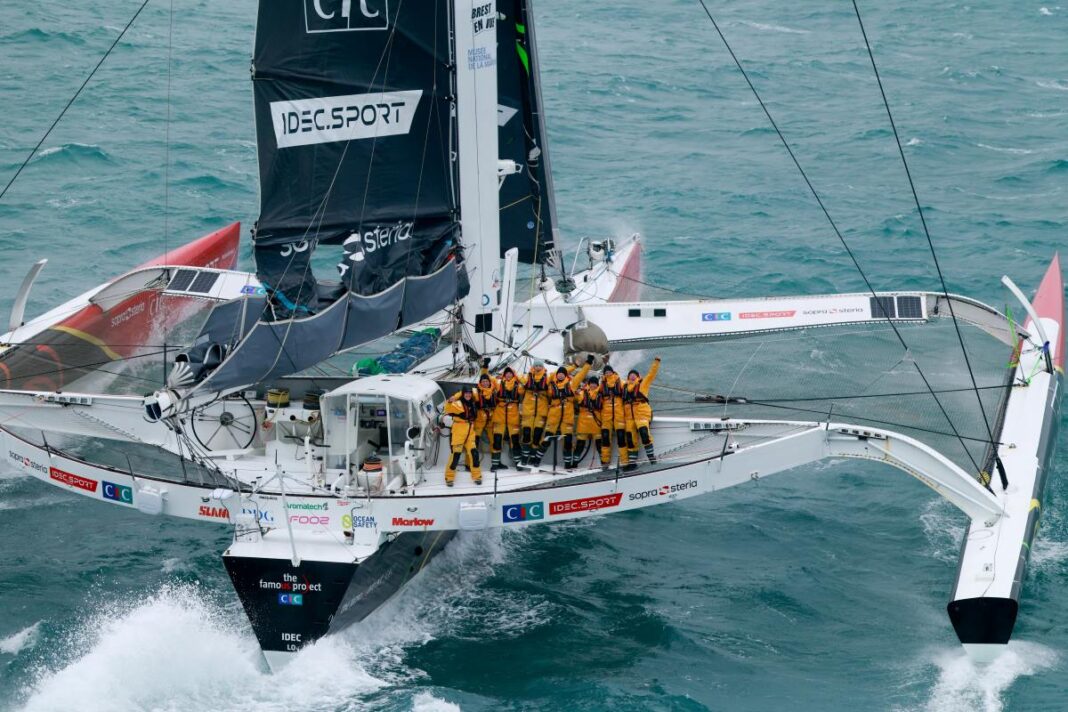
All-female crew of The Famous Project CIC complete first non stop lap of the planet on board a trimaran.
When the crew of The Famous Project CIC—Alexia Barrier, Dee Caffari, Annemieke Bes, Rebecca Gmür Hornell, Deborah Blair, Molly LaPointe, Támara Echegoyen, and Stacey Jackson—crossed the starting line of the Jules Verne Trophy near Ushant on 28 November, they were acutely aware of the monumental record set in 2017 by the IDEC Sport maxi trimaran: 40 days and 23 hours.
Their primary aim was to make history in women’s sport and sailing. They aspired to become the first all-female crew to complete this non-stop circumnavigation. Today, they have achieved their goal after 57 days, 21 hours, and 20 minutes of adventure. Their journey was punctuated by countless racing challenges and unpredictable adversities on the vast ocean. While British sailor Tracy Edwards and her ten-member female crew, the first to attempt this feat, were forced to abandon their dreams off the coast of New Zealand 27 years ago, Alexia and her crew triumphed over all obstacles. They faced damage and winter storms that tested their resilience and determination right up to the last mile.
The Atlantic as a Warm-Up
“The watchword: don’t break anything!” Upon crossing the starting line of her round-the-world race, Alexia announced her intention to sail with caution and rationality, providing her highly international crew—comprising seven nationalities—the opportunity to find their rhythm and put into practice the myriad manoeuvres they had repeated in training. Strong north-westerly winds and rough seas made it challenging to find the right balance without risking the dreaded breakages that have caused numerous abandonments throughout the Jules Verne Trophy’s long history. Abandonment is a term strictly forbidden aboard the IDEC SPORT Maxi Trimaran, which emerged unscathed from the initial challenges of its journey. After repeated gybes in the Portuguese trade winds and a successful transition to the particularly irregular north-easterly winds, interrupted by wind holes, the sailors managed to settle calmly into their routine, dictated by the watch schedules that would become their daily lives for the next eight weeks. On 7 December, Alexia and her crew crossed the equator after eight days and three hours of controlled sailing, despite battling particularly troublesome doldrums.
Picking Up the Pace
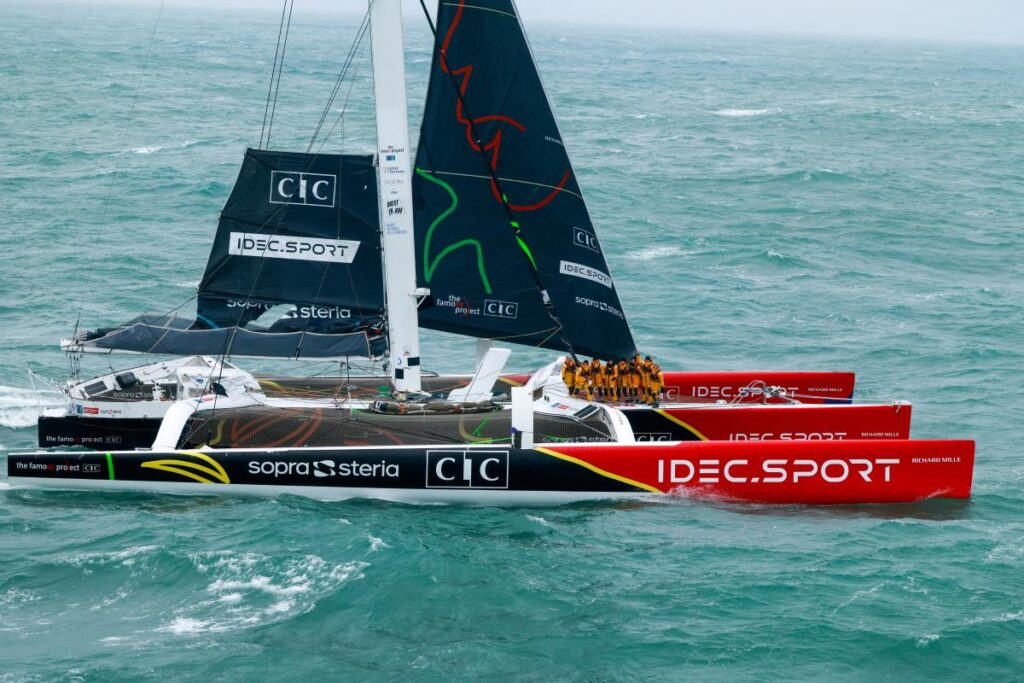
In the tropics, buoyed by the proximity of Brazil and the south-easterly trade winds, the The Famous Project CIC crew grew bolder and more confident as the miles passed, accumulating excellent days with over 500 miles covered, close to the heart of the Saint Helena High. This was an efficient route to the Cape of Good Hope, which they crossed on their 17th day of racing, after covering nearly 8,000 miles at an average speed of over 19 knots. The only fly in the ointment was a stuck mainsail hook—a critical connection between the mast and the sail. A custom titanium part attached to the headboard remained stubbornly jammed, forcing the crew to dismantle it every time they took in or released a reef, requiring them to lower the entire sail to access this part. This was the first obstacle that Alexia and her crew overcame through sheer determination.
To the Rhythm of the Indian Ocean
On 16 December, as they slipped beneath the Cape of Good Hope, the southernmost point of the African continent, the crew on board The Famous Project CIC entered one of the key stages of a round-the-world sailing trip: the Indian Ocean. To begin this important leg, they encountered the Agulhas Current, flowing straight down from the shores of Madagascar, which accelerates under Africa, reaching speeds of up to 3 knots in places. The west wind stirred up a very rough sea on the Maxi trimaran’s route, which severely affected the crew. Alexia, Dee, Annemieke, Rebecca, Deborah, Molly, Támara, and Stacey skillfully balanced steering and autopilot, utilising headsails combined with their mainsail, which was still hindered by the stuck hook. They made good speed out of this unfriendly area, heading further south with each passing mile on an efficient course towards the Kerguelen Islands. They also navigated alongside the Indian Ocean’s steamrollers, where violent centred depressions move through with regularity, forcing them to take a very northern route in the search for optimal wind angle and strength. The maxi trimaran found its stride, and the girls focused on the next major milestone of their round-the-world trip: Cape Leeuwin at the western tip of Australia, which they hoped to reach on Christmas Eve—a lovely gift for the entire crew, especially for the Australian on board, Stacey Jackson.
A Fishing Net for Christmas
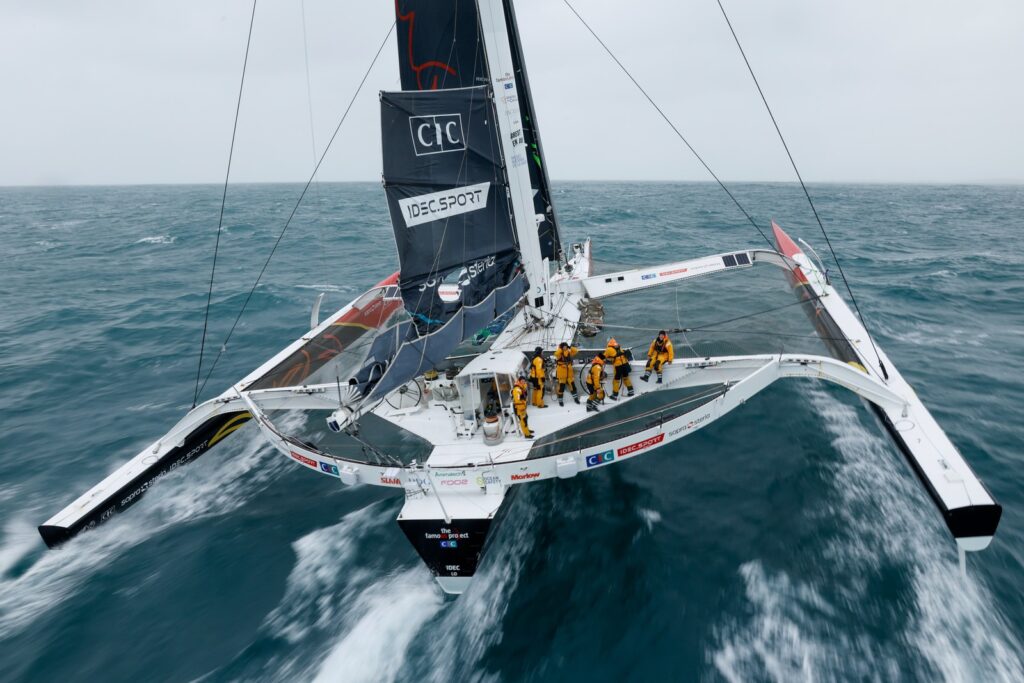
It was at the moment when Australians were opening their Christmas presents that the all-women crew of The Famous Project CIC crossed the longitude of Cape Leeuwin at the southwestern tip of the Australian continent. This crossing marked the second of three major milestones in their round-the-world voyage, having previously passed the Cape of Good Hope on 16 December and headed towards Cape Horn, just 25 days after departing from Ushant.
This particular crossing held deep significance, especially for the newcomers on board, and was celebrated as a wonderful gift at the end of a fast-paced and successful week in the Indian Ocean. The IDEC SPORT maxi trimaran showcased its remarkable seafaring capabilities in rough seas and strong north-westerly winds, enabling the crew to cover nearly 700 miles in just 24 hours at an impressive average speed of over 27 knots. However, this remarkable journey was briefly interrupted that morning when a massive fishing net and its floats became caught in the starboard foil of the multihull. “We went from 30 knots to 5 knots!” Alexia recalled. “We had to put the boat in reverse to remove the large net, but unfortunately, the foil ended up stuck in the down position for a while.” Little did they know, this limitation would later force the crew to sail without this crucial appendage.
A Very Physical Pacific
On 2 January, the crew left Point Nemo, known as the “maritime pole of inaccessibility,” on their port side. This geographical point, situated in the heart of the Pacific Ocean, marks the furthest distance from any land. They also passed the exact location where, 27 years earlier, the first all-female crew led by British sailor Tracy Edwards saw their historic round-the-world voyage come to an abrupt end when the mast of their catamaran, Royal & Sun Alliance, collapsed. At that moment in their journey, the crew became the only fully-female team to have come this far in a Jules Verne Trophy race.
Cape Horn as a Reward
On Tuesday, 6 January, at 3:14 p.m. (CET), the all-women crew’s Maxi Trimaran, IDEC SPORT, rounded Cape Horn. This was a historic moment in the long and illustrious history of ocean racing, as never before had an all-female crew achieved this milestone in a non-stop multihull race. The crew took just under 11 days to cover the distance of 3,800 miles from Leeuwin to Cape Horn. This fast crossing was marked by 48 hours of severe weather, with tumultuous seas and waves exceeding 8 metres, alongside winds gusting over 50 knots.
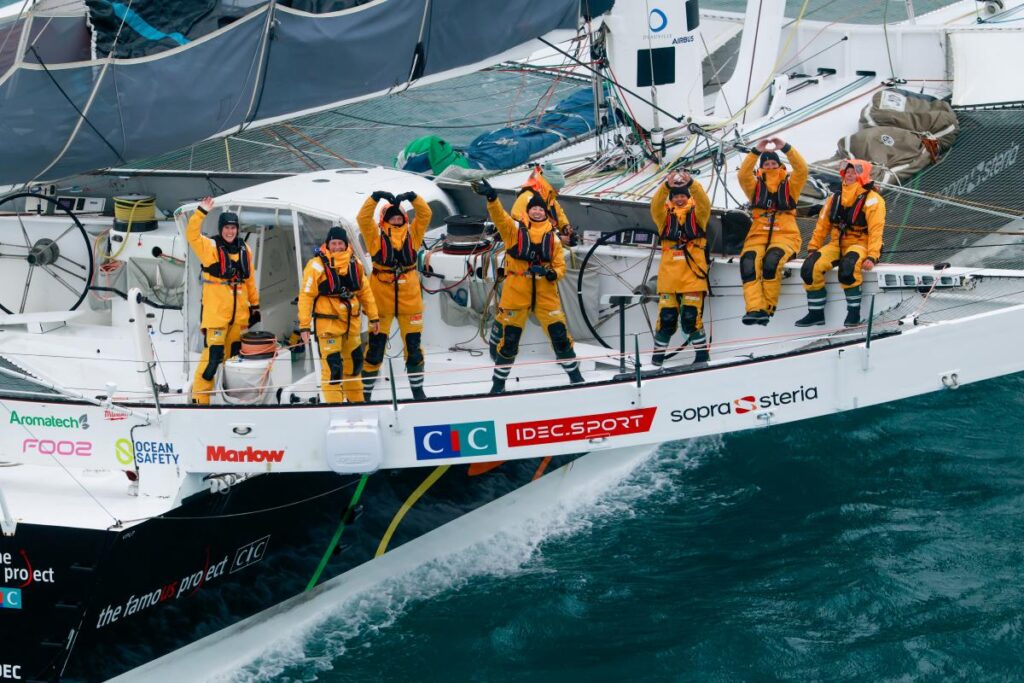
Now perfectly attuned to the manoeuvres and handling of the maxi trimaran, the crew displayed remarkable strength, teamwork, and composure even as they dealt with a stubborn mainsail hook that forced them to take evasive action when managing the sail. This trans-Pacific crossing was characterised by remarkable consistency, with the maxi trimaran regularly covering over 550 miles each day. Though the route leaned towards the north, it proved both efficient and sensible, allowing them to skirt around the violent weather patterns in the Southern Ocean. Enduring fatigue, cold, and snow, the crew maintained their focus on adaptations and ensuring precise piloting of the maxi trimaran. After 38 days at sea and nearly 16,000 miles covered (25,700 km), they were ready to tackle the final leg of their journey: crossing the vast Atlantic.
Standing Tall
The all-women crew had been sailing with their heads held high since 15 January. They crossed the equator once more on their 48th day at sea and could proudly congratulate themselves on their fast and effective sailing in the South Atlantic. After passing Cape Horn in the afternoon on 6 January, it took them just 9 days, 5 hours, and 38 minutes to reach the equator—one of the best performances ever on this route.
True to its reputation, the Intertropical Convergence Zone or more commonly referred to as the Doldrums, known for its tricky conditions, caused unexpected delays, holding back the crew as storm clouds gathered along their route. With the arrival of the trade winds came the dreaded moment of needing to reduce sail area, and the stubborn hook on the mainsail again caused problems. This forced Alexia and her crew to undertake yet another difficult dismantling and reassembly operation, which further hindered their speed. As if trouble always comes in multiples, it was during this delicate reefing manoeuvre that the crew discovered a tear in the leech of the mainsail. A makeshift sail workshop was set up on board, while numerous banks of sargassum seaweed slowed the progress of the boat.
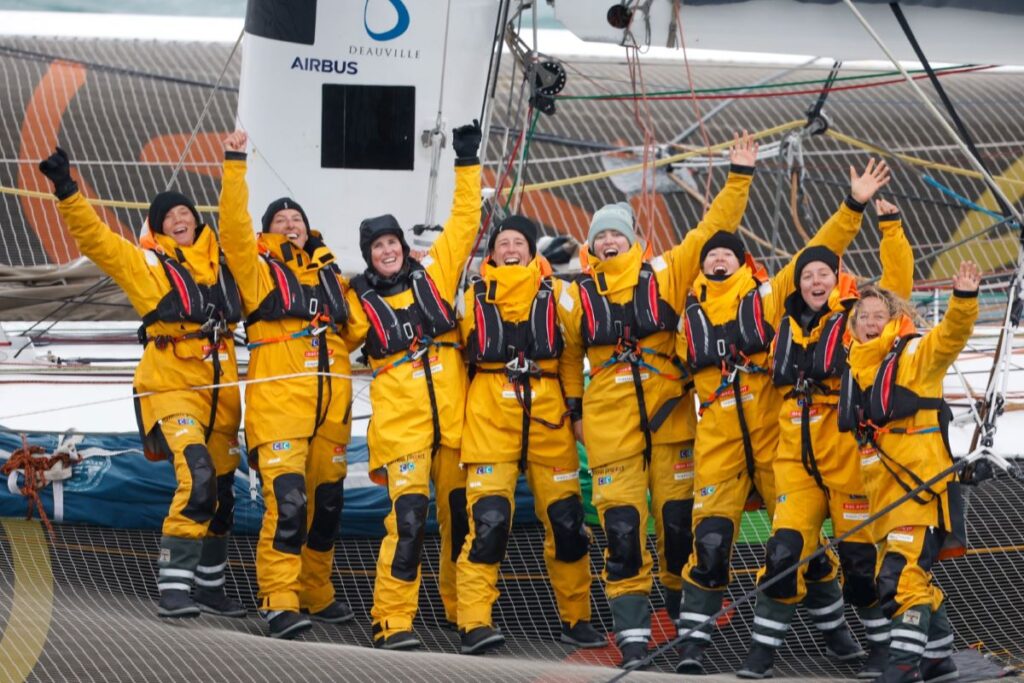
A Tense Finale
“If it were easy, everyone would do it!” This quip from British sailor Dee Caffari, made in response to the first tear in the mainsail of the Maxi Trimaran IDEC SPORT, took on a profound significance a thousand miles from the finish line. The mainsail, which had already torn once at the second reef, literally exploded after 55 days at sea. Without its starboard foil, the maxi trimaran lost the use of its autopilots.
Yet, despite these mounting setbacks, the eight women on board remained determined, gritting their teeth and insisting on completing the race at all costs. They were achieving a monumental feat that no all-female crew had accomplished before: a non-stop circumnavigation of the globe in a maxi multihull.
What had begun as a dream for Alexia from France, Dee and Deborah from Britain, Annemieke from the Netherlands, Rebecca from Switzerland and New Zealand, Molly from Italy and the US, Tamara from Spain, and Stacey from Australia, was now threatened by a formidable winter storm, ironically named Ingrid. Sailing under a single reef and, at the slightest drop in wind, with the assistance of the J3 sail, Alexia and her crew of The Famous Project CIC persevered through their daunting journey, living solely to the rhythm of their three-hour shifts on deck.